Contents
This article was prepared by our expert, SEO Senior Nikita Chizhichenko. Nikita has worked in SEO for eight years, covering different industries and mentoring junior specialists.
The “SEO is dead” narrative comes back every year. 2025 was no exception: some attributed the end of organic search to chatbots, others said AI Overviews would replace classic SERPs. Meanwhile, real projects continued to grow and hit traffic records.
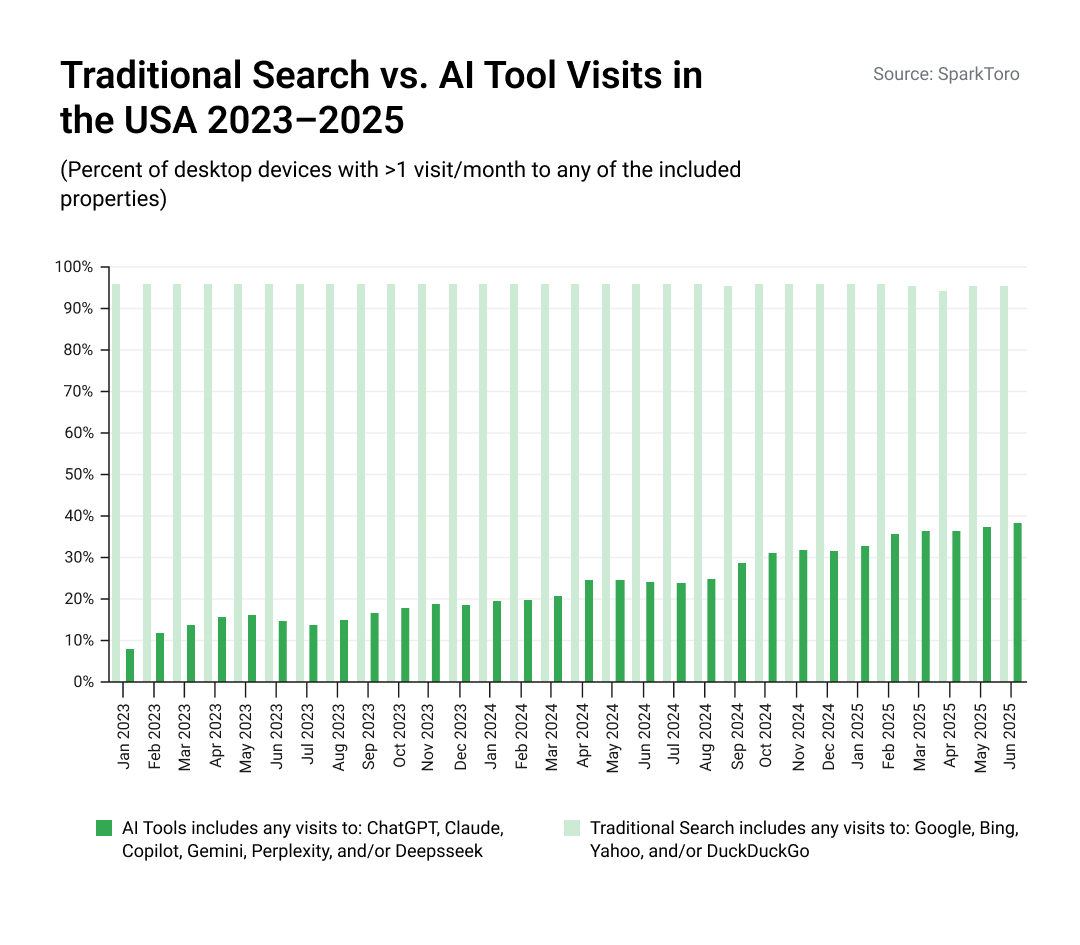
Research shows that more than 95% of users still rely on traditional search. Even though the share of people using AI tools grew from 8% to 38%, the overall search audience has decreased by less than one percent.
The real shift isn’t in search itself. Impressions are growing, but clicks are not — and this comes from changing user behaviour shaped by AI tools.
This is an analytical piece. We look at what shaped SEO in 2025 and how these shifts will influence the landscape in 2026.
If you prefer a quick overview, head to “SEO trends for 2026” — the section includes a summary table with the key points only.
The impact of AI will grow
AI became the main driver of change in 2025. Integrations rolled out across platforms and started reshaping the way people search — from how queries are phrased to how results are presented.
Google and other platforms are not slowing down. In 2026, AI will influence SEO even more, and traffic will continue to split between classic search and new formats such as AI Overviews, chatbots and assistants.
Chatbots
According to Semrush, as ChatGPT’s audience grows, search activity among the same users grows as well.
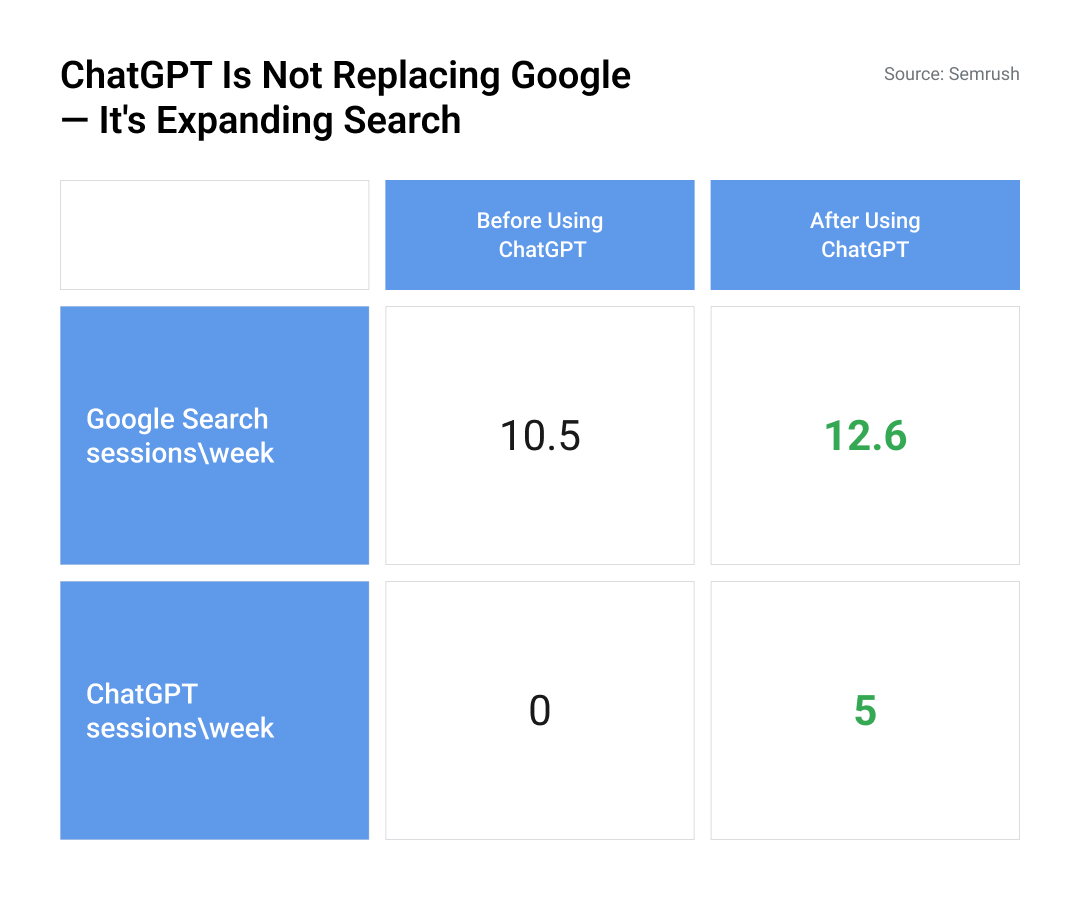
The pattern works like this: people begin with broad, exploratory questions in AI tools and then turn to search engines to look for a specific site or brand. So ChatGPT isn’t replacing search. It’s becoming another traffic source, much like social platforms once did.
Adobe’s analytics highlight another angle. 77% of US ChatGPT users treat it as a full search engine. Among Gen Z (born 1995–2012), 28% start their search directly in ChatGPT. And since this generation already prefers to look for information on social platforms, alternatives to traditional search will only continue to grow. This fragmentation of search behaviour weakens the monopoly of classic search engines.
For now, the share of purchases made through ChatGPT is still small, with around 13% of its users buying directly via the tool. As major platforms build payments and services into chatbots, this share will probably increase. In this context, interest in voice search may also return: telling a bot what you want to buy is easier than typing a query.
As a result, a combined behaviour pattern is forming: people explore options in AI tools, refine their choice in search, and complete the purchase on websites. This pattern became established in 2025 and will stay with us in 2026.
Trend. The search journey is splitting across channels: part of the discovery moves to chatbots, part to social platforms, and classic search engines remain a stage for clarification and selection.
This creates a multichannel search ecosystem where SEO covers both SERP visibility and presence in generative and conversational interfaces.
AI Overview
The rise of AI-generated overviews has had a much stronger impact on search results. If at the beginning of 2025 these blocks appeared in 6.5% of queries, by March the share had reached 13%. They still show up mostly for informational queries, but are increasingly appearing for commercial ones as well.
Google has effectively made AI Overviews a permanent part of search. The company sees them as a way to keep users inside its ecosystem — and judging by revenue, the strategy works.
The idea itself isn’t new.
Featured snippets once played a similar role. But AI Overviews go further: instead of quoting a single fragment, they generate a short, synthesised answer. For a query like “best laptop 2025”, the block might assemble a compact review of several models, listing their pros and cons. The user gets the answer directly in the results and has no need to click through. The traffic stays within Google.
Just as expanded snippets once reduced click-through rates, AI Overviews have led to similar effects. According to Ahrefs, when an AI Overview appears, the average CTR of the first organic position drops by about 34.5%.
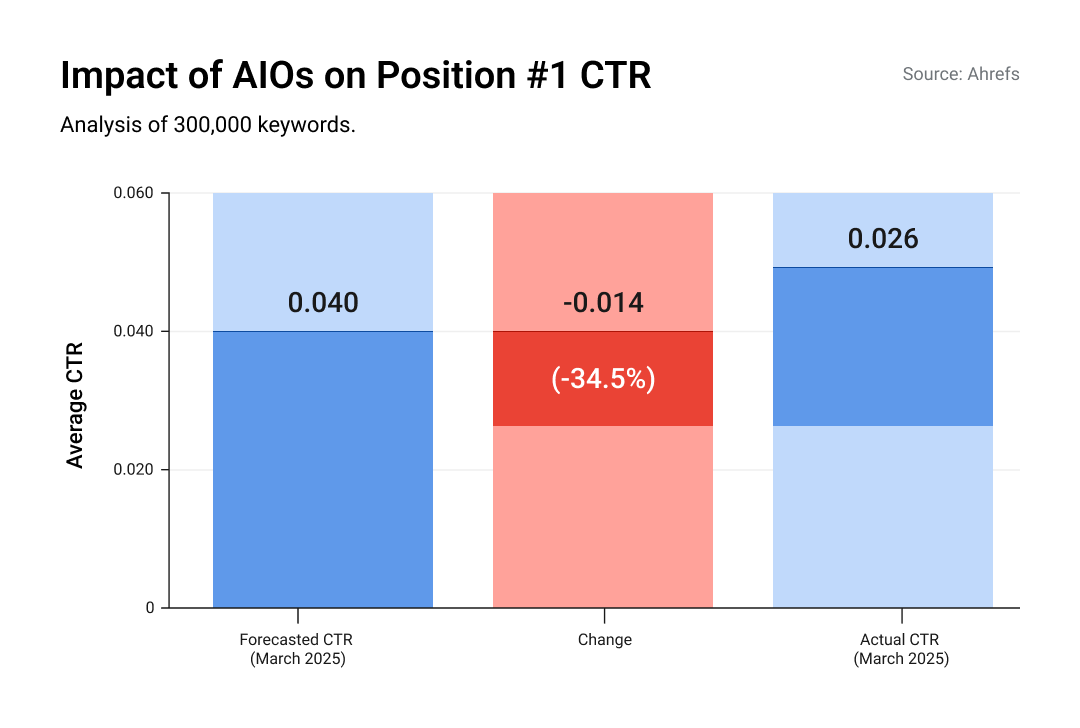
Fluctuations in CTR and rankings are expected in search. The industry has faced them for years — whether due to algorithm updates or new SERP elements like maps, ads, quick answers or knowledge panels that change how users interact with results.
What’s different now is the scale. In some verticals, websites lose up to 80% of their organic traffic. The Guardian wrote about this in relation to news publishers. Few changes outside of search-engine penalties have had an impact of this magnitude. So the question is: how much does this matter across the board?
We understand how it works
and know how to apply it
Our team helps brands appear in ChatGPT, AI Overviews, and other AI-driven interfaces while improving organic visibility and rankings.

Organic traffic: decline or transformation?
Not all traffic declines in the same way. Research shows that AI Overviews have an uneven impact across query types.
According to Ahrefs, generative overviews appear in less than 10% of transactional queries. In Real Estate and Shopping, where commercial intent is high, their rollout is progressing even more slowly.
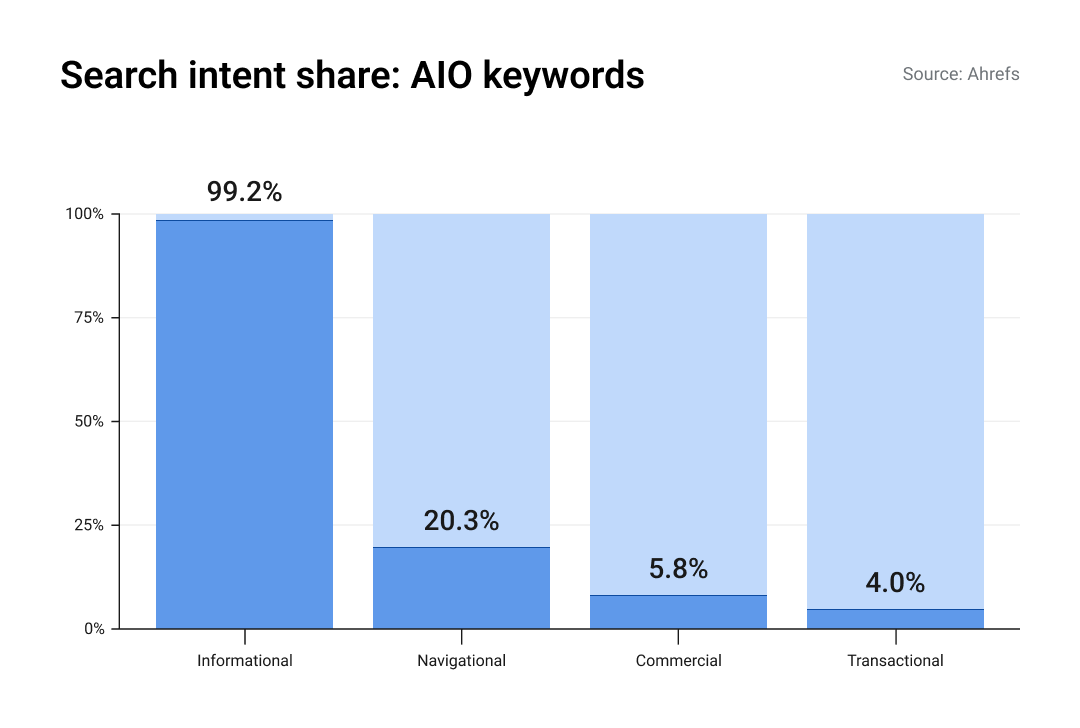
Since November 2025, Google has been testing shopping features directly in search. Users in the US were the first to gain access: they can buy items through AI Mode or in the Gemini app.
In other countries, AI Overviews haven’t yet started to interfere with commercial queries, and these updates will take time to arrive. So why aim to appear there?
A mention of a brand inside an AI Overview already creates recognition. Even if a user does not click, they remember the source — and recognition supports trust.
When trust and loyalty are high, businesses adapt more easily and keep users on their websites.
Well-known brands also gain an advantage. It is easier for them to appear in AI-driven recommendations, where you cannot simply buy attention through ads or visibility hacks.
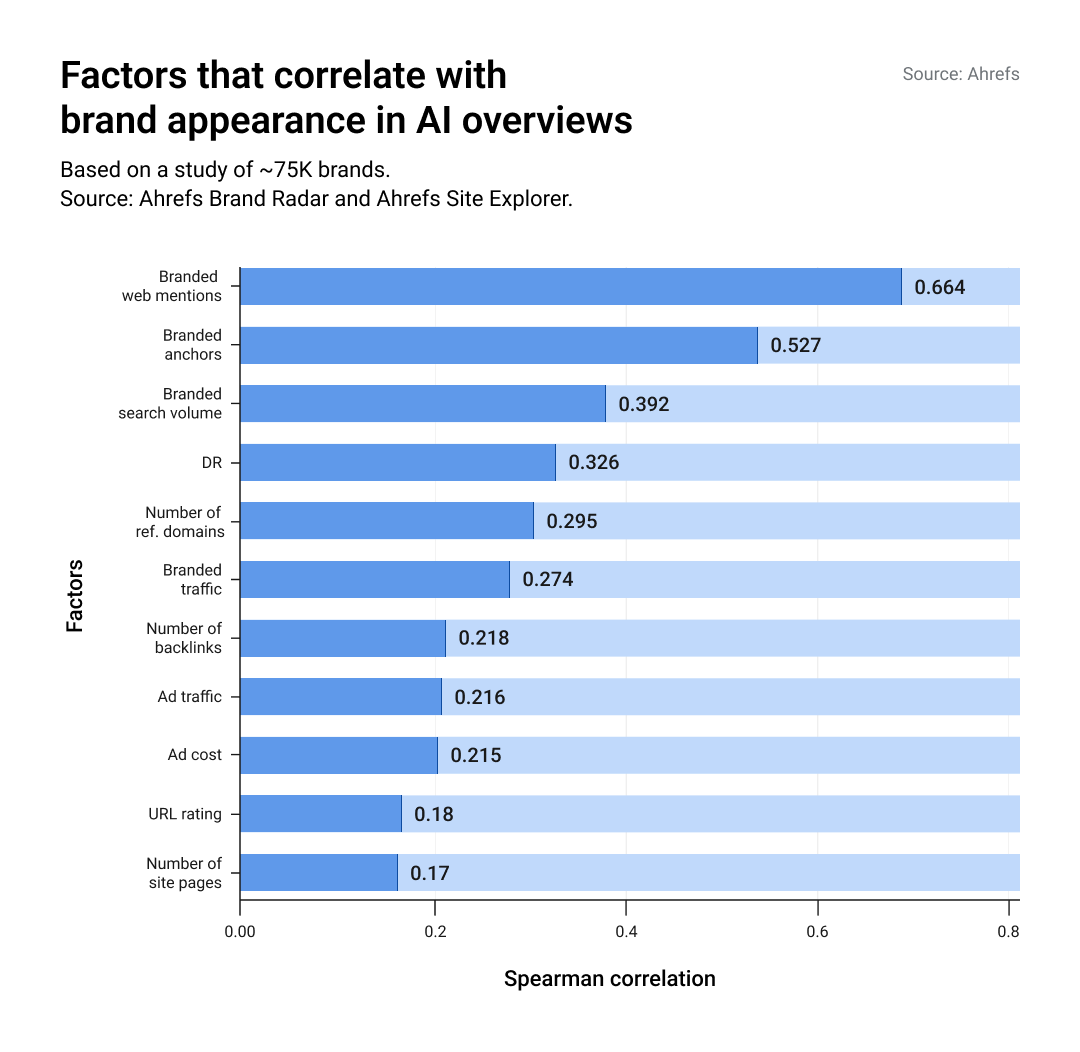
This creates a loop where one factor reinforces the other: recognition drives visibility, and visibility strengthens recognition.
The same logic applies to integrated promotion. A strong reputation, authoritative backlinks, well-designed content and consistent work with reviews amplify each other.
For example, developing SERM and ORM can influence whether a company appears in AI-generated answers. This work includes managing reviews, comments and public discussions about the brand. AI systems analyse tone and context: if there are many reviews but most of them are negative, the model treats the brand as unreliable and avoids showing it. Positive sentiment, in contrast, increases the likelihood of being recommended.
Shape how users and AI systems see your brand
We manage SERM and ORM, address negative signals, strengthen positive ones, and build trust with both search engines and people.
Mentions in authoritative sources can also be part of a broader strategy for link building. For AI-driven systems, links from reputable publications or frequent mentions in trusted public sources signal value.
👉 The behaviour of AI models is predictable: they do not just generate an answer, they attempt to choose the option that, based on their probability models, is most likely to satisfy the user.
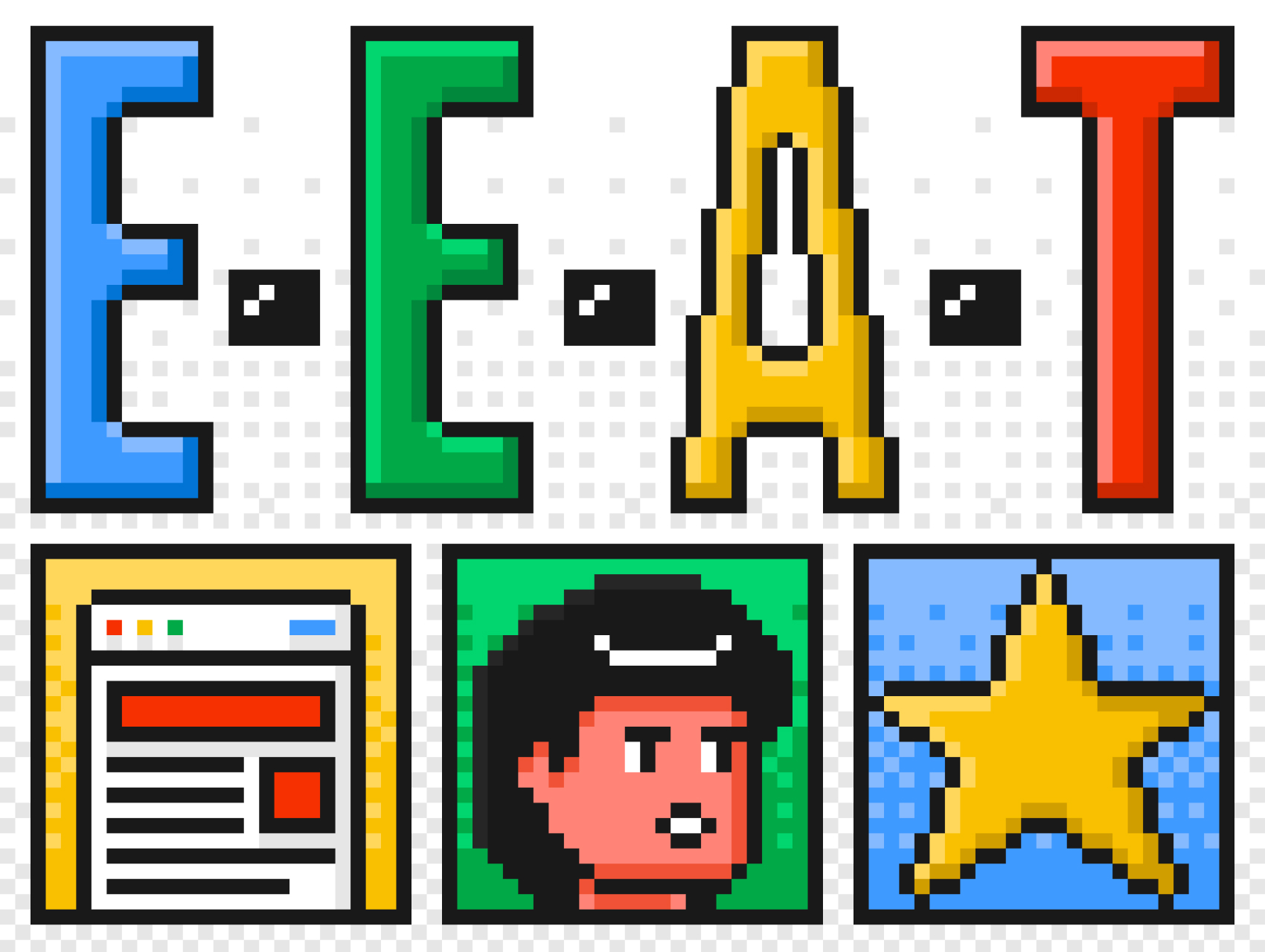
In practice, classic SEO helps here as well. Clear structure, strong E-E-A-T signals, and authoritative backlinks make a page easier for algorithms to interpret and therefore more likely to be selected as a source.
Not everything that works in SEO translates directly to AI. A common misconception is that structured data directly increases the chances of appearing in AI-generated answers. Google has indeed noted the importance of structured data several times (1, 2), but always in the context of indexing and helping algorithms understand page content.
Instead of relying on markup, LLMs understand a document’s structure through the text itself: what is written, how it is organised and which entities appear in the content.
Google points to entities as the key factor for AI visibility. AI Overviews rely on knowledge systems such as the Knowledge Graph — a database of entities (people, places, concepts) and the connections between them.
If your content helps Google correctly identify entities, the chances of those entities being interpreted and used in AI Overviews increase. This happens only when the system decides that updated information about that entity is relevant for the answer.
These processes may change over time, but to keep optimisation effective for both search engines and AI systems, it is worth deepening the relevant knowledge and skills. This approach helps structure content in a way that is clear to both people and algorithms.
SEO trends for 2026
With the context covered, we can now bring all the trends together.
| Trend | What drives it | What to do |
|---|---|---|
| Generative search (GEO/AEO) | Search is shifting from lists of links to ready-made answers. Users interact less with the traditional SERP and more with conversational or generative interfaces. | Provide clear answers, build logical structure, strengthen E-E-A-T, work with entities, and earn mentions on authoritative platforms. Track how the brand and its topics appear in AI Overviews and chatbots. Increase the likelihood of being used as a source for generative answers. |
| Entity SEO | Both classic and AI-driven search rely on knowledge bases like the Knowledge Graph, where information is stored as entities and connections between them. Clear entities improve interpretation. | Standardise entity mentions (brand, experts, locations). Use correct Schema. Work with authoritative directories and platforms. Earn consistent external mentions. |
| Reputational signals (SERM and ORM) | Search engines and AI systems evaluate the tone and frequency of brand mentions. Positive or negative sentiment affects trust for both users and models. | Address negative mentions, monitor tone across key platforms, communicate openly about issues. Publish in reputable sources. Build and show social proof. |
| Diversification / complexity | Search behaviour is fragmenting: part of discovery moves to social platforms, marketplaces, internal app searches and generative tools. The classic SERP becomes only one step. | Manage visibility across all discovery points. Build an integrated strategy combining SEO, PR, content, ORM, SERM and ASO. |
| Content quality | Low-value AI-generated content is increasing. Algorithms strengthen filtering of templated and over-optimised material. | Strengthen editorial quality. Bring in experts. Add facts, research and real cases. Use AI as an assistant, not a replacement for expertise. Prioritise readability and depth. |
| Automation and AI in SEO workflows | Competition increases. AI reduces routine tasks and allows small teams to do more in less time. Risks include AI spam and blind automation. | Invest in automation while keeping expert oversight. Set quality standards and clear constraints. Use AI to speed up workflows, not to replace critical judgement. |
Summary
Beyond search itself, the rise of AI is reshaping the market. Processes are accelerating. Tasks that once took days, including collecting semantics, competitive analysis and brief preparation, can now be completed in minutes with scripts, APIs and AI tools.
👉 Research by Aleyda Solís shows how widespread this shift has become. 62% of SEO professionals already use AI in their daily work. Businesses are moving in the same direction: 85.7% invest in AI-driven SEO, and 61.2% plan to increase their spending.
This changes the role of SEO specialists and of any profession that works with AI. Expertise remains essential, yet even small teams can now execute projects that once required entire departments.
The result is growing competition. Those who adopt new methods earlier gain an advantage. This makes it important to build systems where expertise and automation work together.
It’s time to lead the results page
Get a strategy built for 2026 — effective in both SERPs and AI-driven interfaces.