Contents
AI tools are everywhere now, both in life and at work. ChatGPT, Gemini, Claude, and other models have changed how copywriters and social media specialists approach their tasks. They also made content production cheaper and much faster.
A couple of prompts, and you get a content plan, sales posts, long reads, or email campaigns. The issue is that the internet now has more texts that look neat and polished, yet feel identical and useless. They look like content, but rarely do the job.
Ignoring the technology makes little sense and creates risk. This article explains how to use AI so it helps rather than harms.
Why we are discussing this
According to Firewire Digital, 82% of companies use AI to generate content. That checks out. Copywriters deliver faster, businesses spend less, and the reader… the reader gets annoyed. They see a stream of same-sounding, sometimes tedious texts.
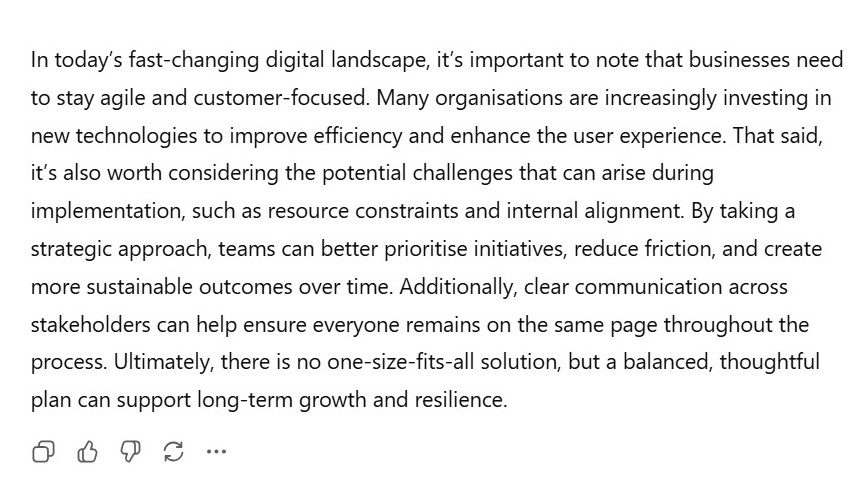
AI-written content often has a few typical traits:
- Generic patterns. AI does not create in the human sense. It relies on the training data and produces something that resembles what it has seen before.
- Bland language. The writing becomes cliché-heavy. Expect repeated sentence shapes and forced positivity. It often comes with corporate-sounding wording.
- Repetition. AI is not a person. It often fails to notice that it is restating the same idea across several paragraphs.
The frustration gets stronger when someone is not looking for an instruction, but for useful career advice or a recipe they can trust for a special occasion. After a year of AI oversaturation, audiences are actively seeking content that feels human, with real experience and an unpolished voice becoming a competitive advantage in 2026.

Overexposure to AI content has led to an unusual effect. People now see “the AI hand” even where there was none. German researchers found that readers correctly identify only 57% of AI texts. The more logical and academic a piece sounds, the harder it is to tell who wrote it.
The effect of unmet expectations
In 2025, companies increasingly looked for people who can work with AI tools. LinkedIn data shows AI hiring is accelerating, growing 30% faster than overall hiring globally since last fall. That is expected. As companies push for more efficiency and automation, they need people who can use AI models in practice.
Still, the wow effect businesses expected from handing tasks to AI did not really happen. According to MIT Media Lab, only 5% of companies achieved the expected profit from adopting AI. The other 95% ran into workslop, work that looks polished but is low quality and still needs to be redone.
A Workday survey found that 85% of employees save from 1 to 7 working hours thanks to AI, but 37% of that time goes into fixing mistakes made by the model.
So everyone is disappointed. Businesses do not get the outcomes they want. Employees redo generated drafts. Audiences ask for content made by real people. Does AI still help, or should the company subscription be cancelled?
What AI is good at
The main advantage of AI is speed. A model can generate a long-form article in minutes if you ask it to write the whole piece. It works better section by section, but even then, writing speed increases a lot.
AI also makes working with sources easier. It can surface relevant information fast and help analyse it. Facts still need checking, but it is usually quicker than doing the full search manually.

AI also makes SEO work easier. It can help find keywords and related terms, and it can weave them into the copy without making the text feel stuffed. A model can do this on its own. Upload the keywords and set the rule once, then review and edit the final text.
So yes, AI is genuinely useful for content. As always, there are a few caveats.
How to work with AI to get the results you need
The key thing to understand about AI tools is this: they are a strong instrument. They are not a magic fix.
A model trained on a huge volume of data cannot think independently. It relies on what it has learned and, in some cases, on what it can pull from the web. AI still struggles to work on its own because it lacks motivation, autonomy, and a full understanding of context.
That is why AI will not replace people. The entry bar for many roles will simply rise. Here is what an experienced copywriter should be able to do when working with AI:
- Trust, but verify. The fact that an AI model, like any other source, can mislead is not news. Fact-checking is a key part of the job.
- Watch the logic of the narrative. It helps to track whether the text jumps between ideas. It also helps to align the draft with the structure suggested by the SEO specialist and remove repetition along the way.
- Show examples. In content marketing, AI plays the role of a junior. Before expecting results, it needs to be shown what “good” looks like. For example, the chat can include samples of the tone the brand uses.
- Edit. AI does not write perfectly. Sometimes it sounds too dry, sometimes too casual. It often leans on filler phrases, generic wording, and repetition. You may also see overly polished corporate tone, hedging, or vague claims without specifics. These issues need to be cleaned up. It helps to treat the draft the way a professional editor would.
- Use text-quality tools. In the original, the gold standard was a set of tools — Grammarly, Hemingway Editor, and LanguageTool. Improvements can also be requested from the model itself: a separate chat works well, with the model given an editor role and a clear task.
In practice, these are the same skills strong copywriters had before AI. Now they work even better, because AI can and should be used to create helpful content. A few things matter:
- Focus on audience needs. A clear need or pain point helps avoid shallow articles. Context matters too: who the reader is and what they need. The more relevant inputs, the better the output.
- Think through the structure. The workflow stays the same as before: follow SEO requirements and plan what to say and when.
- Do not generate the whole text at once. Quality drops and the result turns into a superficial draft. A better approach is to generate the intro, then the first section, then the next ones. If the output is weak, the prompt needs rewording, or the model needs to be asked to expand the idea.
- Keep the brand tone. A common issue with AI text is that it all sounds similar. Even with good editing, models struggle to hold a consistent tone of voice. Each piece still needs a check against the brand voice.
- Add emotion. AI often sounds fake: unnatural, overly sweet, or indifferent. More and more readers are looking for sincerity.
AI is a useful tool that can be trained. It can take on part of the work, but most articles still need to be developed together with it. That is fine: time goes into the right places, and the end result stays high-quality and genuinely useful.
👉 More practical SEO and AI notes are on our LinkedIn. Short tips and examples you can apply to real tasks.