
Contents
What Is SEO Content and How to Create It
You select specific keywords and then write articles incorporating them. That’s what many think when they hear “search engine optimisation (SEO),” but there’s much more to it. SEO requires creating a strategic plan, implementing that plan, and making occasional adjustments to draw traffic to your site.
You need a systematic SEO approach, which this guide will help you formulate. Read on to learn what an effective SEO strategy looks like and how to create highly optimised content that drives organic traffic.
What is an SEO content strategy?
SEO content strategy is a detailed plan that guides how you research, create, optimise, and promote content to attract organic traffic. It includes identifying which topics to cover, the search intent for these topics, and creating high-quality articles that attract readers through search engines and AI chatbots.
Why an SEO content strategy is important
Your SEO content strategy is vital to your website’s continued success. It ensures you create content that aligns with search intent, attracting engaged readers instead of visitors who won’t spend as much time on your site.
As a site owner, a structured SEO content creation strategy is non-negotiable. It’s the difference between running a website with average viewership and one that thrives with an engaged audience.
How SEO content strategy supports organic growth
An effective SEO content marketing strategy ensures you create informative content that aligns with search content. Such content improves visibility in search engines and draws citations from AI chatbots. Improved visibility translates to higher organic traffic.
With effective content SEO strategies, you can build a high-quality, engaged audience while spending little on advertising. It gives a significant competitive advantage as many sites vie for a similar target audience.
What does creating an SEO content strategy involve?
Creating an effective SEO content strategy requires a structured, multi-step approach. It starts with identifying your target audience and follows many steps all the way to creating and updating optimised content. Let’s explore these steps below:
Step 1: Define your niche or industry
Identifying your niche is the first step to creating effective content. What industry is your content focused on, and what are the general trends in that industry? Is readership growing or reducing in the niche? Who are the top competitors? These are key questions to answer with extensive research.
Check industry blogs, survey sites, news sites, and other sources for information about your niche. A niche with a growing audience serves you best, as there are expanding opportunities to latch onto. Niches with little growth prospects can work, but they’re tougher to break into.
Assess existing content from competitors to get a hint of what works or doesn’t. With your niche defined, it’s time to move on to the next step.
Step 2: Identify your target audience and their pain points
Precisely define your target audience and their pain points, which your content wants to solve. Have a clear demographic description, including the age, location, gender, and interests of your ideal audience.
For example, an automotive blog targets people aged 25 to 54 who are in their prime buying age. This niche is historically male-dominated, although the female audience is gradually increasing, so males are the primary target. People buying cars usually have mid-to-high disposable income and live in urban or suburban areas. Hence, an ideal target audience for this blog is
- Males aged 25 to 54 with high disposable income living in cities.
For the above audience, the pain point is finding their preferred automobiles in a sea of many options. Some like EVs, while others like internal combustion engine (ICE) vehicles. Some are focused on affordability and reliability, while others focus on safety and fuel efficiency. The SEO content planning strategy will revolve around guiding this audience towards the best options.
Step 3: Research the topic and market
After identifying your target audience, carefully research their pain points, sought-after topics, and general market trends.
Understand the search intent, which denotes what users search for and why. Intent can be:
- Informational: a user seeking answers to their questions.
- Transactional: a user intending to buy a product and comparing different options.
- Commercial: Someone who seeks out a specific product they have in mind.
- Navigational: Someone who looks for a specific site.
You can analyse search intent from the above perspective. The idea is to understand what information your audience needs, then building an SEO content strategy focused on delivering that information.
People often search the web for solutions to problems they encounter, so an ideal content strategy should focus on creating problem-solving content. Users who visit your site should have their curiosities satisfied, encouraging them to seek more content.
Step 4: Conduct keyword research
The next step is conducting comprehensive keyword research. This research allows you to find and analyse the words or phrases that are popular with your target audience.
Earlier on, we gave an example of an automotive blog seeking a precise target audience. In that case, popular keywords from the target audience can include “Best EVs to buy in 2026,” “The most fuel-efficient cars of 2026,” “The best-looking SUVs,” and “Emerging car brands.” Keyword research helps the automotive blog owner discover the most highly searched words or phrases, then create in-depth content that answers the search queries.
Keywords can be:
- Primary/short-tail: Single words or 2 to 3-word phrases with high search volumes, e.g., “Escalade SUV” and “Fast cars.”
- Long-tail: 3-word or more phrases with lower search volumes but higher conversion rates. These keywords are highly specific, such as “The best cars to drive in Colorado” and “The best EVs to buy with available government rebates.”
You could brainstorm short and long-tail keywords based on your understanding of a niche. However, the most efficient way is to use an SEO tool like Semrush or Ahrefs. These keyword tracking tools have vast databases stocked with data collected from search engines over the years, and these databases keep getting updated. After entering a few metrics, you can quickly identify the most sought-after keywords in your niche through these databases.
For each keyword identified on Semrush or Ahrefs, you can view the search volume, search intent, and competitive difficulty. This way, you’ll work with concrete data rather than guesswork.
Step 5: Identify entities and build semantic topics
In SEO, an entity is a unique, distinct concept characterised by a name, attribute, and relation to other entities. It enables search engines to understand the context behind a word rather than just matching keywords.
For example, “Apple” can mean the fruit or the famous company that produces the iPhone. Entities are what enable search engines to differentiate between them on your site.
Site owners need to identify and create entities through these steps:
- In-depth content. Write in-depth content that covers related topics, helping search engines understand the context behind keywords.
- Internal linking. When a specific article links to other related articles on a website, search crawlers can understand the topic better.
- Structured data. You can use schema markup code to explicitly define the context behind a word or phrase.
High-quality content is less about incorporating keywords than creating informative articles that answer the user’s question and cover related topics. Keywords can attract people to your site, but informative content keeps them engaged and wanting to click more pages. The more time people spend on your site, the higher reputation assigned by search engines, and the more likely it’ll be recommended to others. Building entities and semantic topics is a critical part of every content strategy for SEO.

Step 6: Build Topical Authority and Knowledge Graph Connections
To build topical authority, you need to create in-depth, interlinked content that convinces search engines of your site’s reputation. For example, an automotive blog can write in-depth guides for readers seeking to buy different types of cars (Best Sedans to Buy, Best SUVs, Best sports cars, etc.), and each guide will contain links to other related guides. This interlinking helps convince search engine algorithms that the site is a trusted, reliable source.
Map your core niche and break it down into various topics and subtopics. Then, create content around these topics and interlink them. Over time, your site will build informative depth that’ll enable it to outrank competitors. You can analyse competitors’ sites directly to note their content gaps, then create content that fills in these gaps.
When people search for content on Google, they’ll often encounter a Knowledge Graph that looks like this:
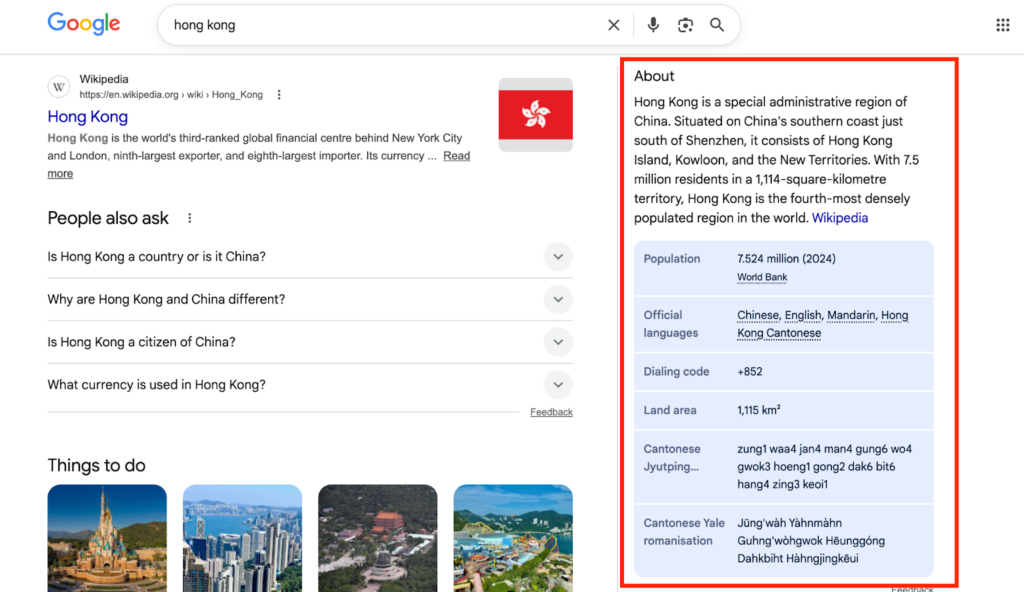
For every piece of information available in this Graph, Google cites the website where it was obtained from. The Knowledge Graph is the most prominent part of a search results page, so any cited website gets more clicks. You can optimise content to improve your chances of getting cited in a Knowledge Graph. Follow these key steps:
- Use structured schema markup to define entities on your website. For example, schema code helps crawlers differentiate a product listing from other content, and the product, its description, and price will be accurately indexed.
- Create a Google My Business profile and fill out all details, including your business hours, description, contact information, and photos. These details will be cited in a Knowledge Graph when someone searches for your business name.
- Create structured content, with headings (H1, H2, H3…), bullet points, and numbered lists that help crawlers easily understand the information.
- Get backlinks from other sites in your industry, as external links signal trustworthiness to search engines.
We plan your SEO content so you do not have to
From topic selection to structure and priorities, we build an SEO content strategy that gives your team direction and saves time.

Step 7: Generate content ideas
Generate compelling content ideas that will attract visitors to your site. We’ve emphasized the need for content to be informative and well-structured. Articles should directly answer the questions that users search for. They should be original, in-depth, and provide unique insights instead of rehashing mundane information. Figures and external data should be cited, headlines should be persuasive, and paragraphs should be concise.
Google follows the E-E-A-T (Expertise, Experience, Authoritativeness, Trustworthiness) framework to evaluate content quality, so ideas should be centered around this framework.
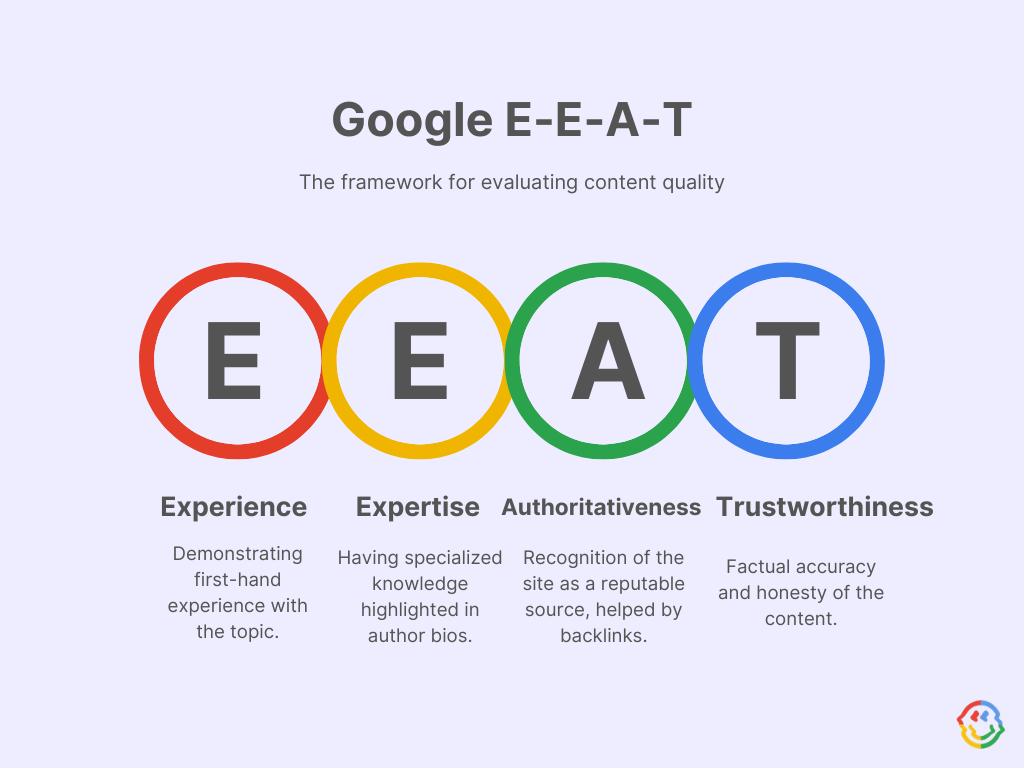
- Expertise highlights the author’s specialised knowledge and credentials, so having an author bio helps.
- Experience demonstrates the creator’s first-hand experience with the topic they’re writing about. Writing in a conversational tone with real-world examples helps in this criterion.
- Authoritativeness indicates the site’s reputation to Google. Having backlinks helps greatly here.
- Trustworthiness denotes how accurate the information is with respect to industry consensus. It also accounts for the security of a website (e.g., insecure websites without SSL certificates are deranked by Google).
In summary, content should be persuasive, demonstrate expertise, and provide factual and in-depth answers to your audience’s search intent. You can brainstorm ideas yourself or enlist the help of AI chatbots. Trained on vast amounts of information, AI tools like ChatGPT are good at suggesting content ideas for unique demographics. They can suggest not just ideas but also create outlines to follow when writing the content.

Step 8: Define your unique angle and content positioning
The most recommended articles offer unique perspectives rather than just generic information. Unique content blends the creator’s expertise and viewpoint with general information.
For example, if writing about “The best EVs of 2026” for an automotive blog, the post won’t just be the names of the EVs and their specs, as readers can find this same information everywhere. Rather, you’ll state what makes each highlighted EV unique and compare its performance with the rest, such as
- “The Tesla Model X has a range of up to 645 km, while the BYD Sealion offers up to 710 km, but the Model X offers a larger 6/7 seat configuration and superior, supercar-like acceleration. I think the Model X wins in premium performance, while the Sealion is a more budget-friendly option…”
In the above example, the author doesn’t just provide generic information about both EVs. It answers what, why, and when to choose one over the other. Such a unique angle is how content should be written on every topic.
Other tips to note include:
- Open articles with a bold statement, curiosity-triggering questions, and relatable examples to grab the reader’s attention. It can be something like “Rising petrol costs have probably eaten into your budget, and it’s rational to consider switching to an EV to future-proof your wallet. But choosing an EV in a sea of many options gets challenging. Lucky you! As you’ve arrived at the perfect place to learn how to choose an EV based on your unique transportation needs…”
- Use consistent messaging and style across all articles.
- Discuss what you believe competitors aren’t focusing on. The opinion could be contrarian, but audiences won’t have problems with dissenting opinions that encourage valuable discussions.
Step 9: analyse existing content and content gaps
An effective SEO and content strategy is analysing competitors’ sites to note content gaps. What content do you think competitors do not cover, or if they cover, do not pay much attention to? This gap could be the golden opportunity to attract readers to your site.
For example, an automotive blog owner can analyse competitors and observe that little attention is paid to newer Chinese EVs by U.S.-centric automotive blogs. Then, they can close that gap by extensively reviewing newer Chinese EVs for a U.S.-based audience. This strategy attracts high-quality traffic by providing in-depth information not easily found on rival websites.
Site owners can manually scour through rival websites to analyse content gaps. After scouring multiple sites, intuition can help them identify which content gaps need to be closed.
SEO tools like Semrush also help with identifying content gaps. They analyse rivals’ sites and, paired with extensive search engine data, pinpoint content gaps that can be closed. These tools achieve more with less effort, so instead of spending endless hours brainstorming on content gaps, you can identify them within minutes.
Step 10: Build topical clusters and content structure
Strong content structure is as important as the content itself. An article should be arranged in a way readers can easily understand, with a clear logical hierarchy using H1, H2, and H3 headings. Content should be broken into short paragraphs to make it easy to digest. Use bullet points and numbered lists to improve scannability. Insert images and infographics, as people generally don’t like reading long pieces of text with no visuals in between.
- Use one H1 for the main title, H2 for main sections, and H3, H4, H5… for subsections. Incorporating keywords into headings helps with search rankings.
- Keep paragraphs concise. 3 to 5 sentences is the ideal length to ensure readability.
- Use images and videos to break up text. Every image should have an alternative text that describes its content to search engines. Search crawlers depend on this alternative text to understand the context behind images.
Topical clusters are a related SEO content strategy, where content is structured into “pillars” (broad topics) and “clusters” (subtopics). A pillar is a comprehensive page that covers a broad topic, whereas clusters are detailed articles that address specific subtopics.
For example, a “Guide to the Best Cars of 2026” can be the pillar, and the clusters will be “The best EVs of 2026,” “The Best Sedans of 2026,” “The Best SUVs of 2026,” etc, and all clusters will be interlinked. By building topical clusters, this sample site signals that its expertise in a topic (automobiles), causing search engine algorithms to give it higher rankings.
Step 11: Create an SEO content plan
With the valuable information we’ve covered above, you can begin creating a detailed content plan in line with your SEO strategy.
Develop a content calendar that outlines the topics to cover, the content formats (short blog posts, long detailed guides, videos and infographics, etc.), and the publishing dates. A formal content calendar helps you stay consistent with your posting.
Define key performance indicators (KPIs) to measure the success of your SEO strategy. The typical KPIs are organic traffic increases, improved rankings for specific keywords, and higher conversion rates of visitors.
For sites with multiple authors, the administrator should ideally create a guideline that should be followed for each article. The guideline can specify:
- The tone of articles, e.g., instructing authors to adopt a conversational tone.
- The preferred length of paragraphs and for the whole article.
- The version of English to adopt (American or British English) based on the target audience.
- The minimum number of images to be included in each article.
- What phrases should or shouldn’t be used.
- The preferred sources to cite.
- A minimum number of internal links for each article.
Step 12: Create and optimise SEO content
Based on the plan created above, you can begin creating in-depth, high-quality content for your target audience. Here’s a rehash of what makes content high-quality:
- It should satisfy the reader’s intent. Anyone who searches for a topic and heads to your site should have their curiosity satisfied.
- Cover topics thoroughly, giving a complete picture instead of just surface information. Dive deep into the nuances of a specific topic.
- Offer unique insights, relatable examples, and personal experiences about a topic. Unique insights differentiate a site from rivals covering the same topic.
- Include high-definition images, infographics, and videos to add context and enhance the reader’s understanding.
- Cite reputable sources when discussing figures.
- Provide factual information in line with industry standards.
- Add keywords naturally into an article. Avoid keyword stuffing, as search engines penalise this tactic.
- Write for a human first, not for search engine crawlers. Assume you’re conversing with a real person and write from that perspective.
Step 13: Update and refresh existing content
Facts and figures change over time, making updates an essential part of content marketing for SEO. Site owners should frequently refresh content with new information or edit existing information. For example, a site that provides tourism guides must stay updated with new travel guidelines released by government agencies. From changing visa policies to travel restrictions and flight bottlenecks, readers need up-to-date information about the places they plan to visit.
Updated content helps maintain high search rankings, as readers keep returning for more. Search engines derank outdated information in favor of more up-to-date content, so there’s fierce competition in this criterion.
Add new statistics, add new keywords, optimise internal links, or even revamp whole articles. Updating existing content is faster than creating new pages, which will take some time to garner high search rankings.
There’s no specific schedule for updating content. Rather, it depends on your niche and target audience. Content can be updated daily, weekly, biannually, or annually, depending on the topic.
Step 14: Measure SEO content performance
Earlier on, we mentioned setting key performance indicators (KPIs) to measure the success of your SEO content tactics. These KPIs should be tracked thoroughly, and strategies should be adjusted if the optimal results aren’t obtained.
Key metrics to track are:
- Organic traffic: What’s the percentage increase in visitors arriving from search engines?
- Keyword rankings: A site’s position for specific keywords, as measured by Semrush, Ahrefs, and other SEO tools.
- Conversion rate: The percentage of visitors completing suggested actions, like subscribing to your newsletter or clicking on an affiliate link.
- Backlinks: The number of new backlinks obtained over time.
- Engagement: What’s the average time a visitor spends on your site? The more, the better.
Google provides free tools, including the Search Console and Google Analytics, to track key metrics. You can also use other tools to keep tabs on KPIs and know when to adjust SEO strategies.
Conclusion
With the right SEO content marketing strategy, websites get a steady stream of organic traffic without spending much on ads. A little effort here and there, and you can build a loyal following through effective SEO. We’ve outlined the key steps for effective SEO content development, which any site owner can easily follow. Prepare your servers for higher traffic as you implement these steps!
SEO content strategy FAQ
How long does SEO content take to rank?
It typically takes 4 to 6 months for optimised content to earn high search engine rankings. Breaking into the highest search rankings can take up to 12 months. SEO isn’t a quick-results strategy. Rather, it takes some time for optimisation efforts to achieve the desired results.
How many keywords should one page target?
There’s no specified range, as it varies depending on page length, but an ideal structure is to target one primary keyword and support it with 4 to 10 related secondary keywords. Short content of 500 words or less can target 1 to 3 keywords, while long content of 1,000+ words can target 10 or more keywords.
How often should you publish SEO content?
Quality matters more than quantity when it comes to website content strategies. 1 to 4 high-quality posts per month is a good starting point, but it could be much more based on your niche. For example, news sites post much more frequently than regular blogs.
Should you update or create new content?
Updating older content is generally better, as you’ll maintain the page’s existing search engine authority instead of a new page, where you’ll have to build high search rankings from scratch. Updating offers faster results than creating new content. However, don’t hesitate to create new content when needed to target new keywords and emerging topics.
What makes content rank in Google today?
Pages receive high Google rankings when they fulfill various criteria, including having a good user experience (speed and mobile-friendliness), quality backlinks, updated information, and providing original insights with in-depth coverage. Content that answers specific questions rank high on Google.