
Contents
Your future customers are out there searching for exactly what you offer, but they’ve chosen your next-door competitor because it outranks you on Google. Why did that happen? Probably because your local SEO strategy isn’t as detailed as the competitor’s. Local SEO helps your physical business get noticed on Google and attract new customers.
Ahead is an explanation of local SEO, why it’s worth your attention, and how to improve it without getting mad at yourself, your competitors, or Google.
What is Local SEO?
Local SEO is the process of optimising your business’s online presence to attract visitors from location-based searches. It focuses on making your business appear in “near me” or “local packs” search engine results pages (SERPs). Key steps include managing a detailed Google Business profile, optimising for local keywords, and getting mentions from local review sites.
How local SEO differs from traditional SEO?
In local SEO optimisation, the aim is to rank high for geographic-specific keywords and attract nearby customers. In contrast, a traditional SEO strategy aims for broader national and global visibility, not specific cities, towns, or neighbourhoods.
A local SEO strategy targets users seeking nearby solutions (e.g., “event halls near me”), while traditional SEO targets a wider audience seeking information that isn’t specific to any location.
Examples of local search queries
Here are typical examples of local search queries that businesses optimise for:
- “Best pizzas near me.” Here, a user searches for the best pizza spots in their vicinity. Pizza outlets that rank high for this keyword will attract a steady stream of new customers.
- “Things to do in Denver.” This query indicates someone searching for fun activities in the city of Denver. Local businesses that offer fun activities can target this keyword and position themselves to visitors or city dwellers seeking to have fun.
- “24/7 pharmacy.” In this simple query, a user searches for pharmacies that are open 24/7 in their vicinity. A pharmacy store mentioned in the search results page will likely receive a visit.
Local search queries are characterised by the searcher’s high intent to purchase something or visit somewhere.
Why local SEO is important for businesses
Local SEO works because it catches people in the exact moment they’re searching for something. It increases visibility in “near me,” “things to do,” and similar search queries, attracting significant foot traffic. Smaller companies can compete better with larger businesses by implementing the right local SEO strategies.
Growth of local search and user behavior
Localised searches are experiencing rapid growth. Recent data indicates that 46% of all Google searches are for local information, and 92% of searchers choose businesses on the first page of search results. These stats highlight the increasing importance of local search optimisation for businesses.
With the right local SEO strategies, you can attract foot traffic like never before and grow your business without spending much on paid ads. Local searches have high purchase intent, so targeting the right audience leads to improved sales.
Benefits of appearing in local search results
- Increased visibility to your precise target audience.
- Increased foot traffic, which translates to higher revenue.
- It gives a competitive advantage over larger businesses with more advertising and content creation resources.
- A higher return on investment than paid ads. Most SEO efforts are implemented at the initial stage, and you don’t have to spend frequently to maintain higher traffic levels, unlike ads.
- It provides a better user experience for your customers, as they’ll know your exact opening hours, pricing, and services.
How local search works
For localised queries, Google uses a specialised search algorithm to deliver geographically relevant results. If the searcher indicates a specific location, Google shows results for that exact location. If no specific location is indicated (e.g., “Grocery stores near me”), the searcher’s location is identified via GPS or IP address, and Google uses this information to show locally relevant results.
The role of relevance, distance, and prominence
Local search results rely mostly on
- Proximity. How close is a business to the searcher’s location?
- Relevance. How well does the business’s profile match the searcher’s intent?
- Prominence. How popular is the business, based on its online mentions and customer reviews?
What is the Google Local Pack?
When a user makes a local query on Google, the algorithm often displays a map with the top three business listings matching their query. This block is known as the Local Pack, displayed at the top of the search results page to highlight the most relevant options. It looks like this:
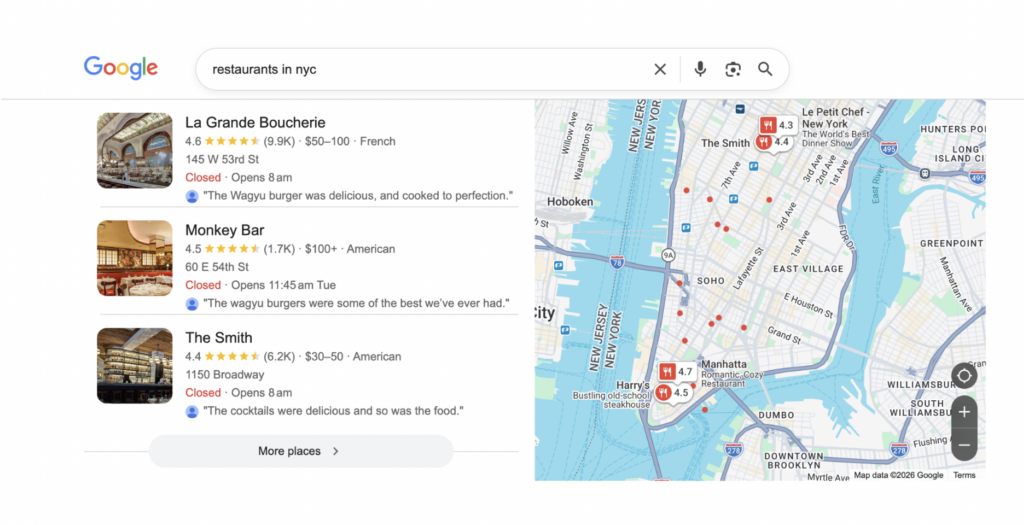
Businesses listed in a Local Pack get the most foot traffic compared to rivals listed below. There’s intense competition to get listed, and optimisation helps you climb over rivals.
How Google determines local rankings
Google determines local rankings through the three factors we mentioned earlier: relevance, proximity, and prominence. This implies that:
- Businesses need a detailed profile to help Google determine their relevance for search queries.
- Trusted businesses with positive reviews and mentions are more likely to rank higher.
- Websites optimised for local keywords tend to rank higher.
Key components of an effective local SEO strategy
You’ve learned how local search works and how Google determines rankings for local results. Now, it’s time to learn the key steps of optimising your business to rank high in local search results. They include:
Optimise your Google Business profile
Every business can create a custom profile on Google, filled with details like their address, contact information, opening hours, reservation information, price ranges, and high-quality photos. Customer reviews are displayed in this business profile.
Having a complete Google Business profile is necessary for ranking high in search results. Google uses this information to determine your business’s relevance to search queries. The information also keeps customers informed about important details like prices, opening hours, and temporary closures.
A Google Business profile is free to create. Simply enter Google Business Profile and follow the instructions to create one. Afterwards, you can update the profile anytime to keep customers informed about important changes.
Build and maintain local citations
Businesses with external citations rank higher on local search results, as Google considers these citations as a vote of confidence. Effective local SEO in digital marketing includes getting mentions from trusted sources like review sites, industry-specific blogs, and other businesses.
For example, hotels benefit from mentions on Tripadvisor, a prominent travel booking site. New York City-based outlets benefit highly from mentions on Curbed.com, a popular local real estate publication.
Target citations from sources relevant to your location. For example, create listings of your business on third-party sites like Tripadvisor. The more your business gets mentioned on external sources, the better.
Encourage and manage customer reviews
Encourage customers to leave reviews on your Google Business Profile. Respond to positive reviews in an appreciative manner and negative reviews in a reconciliatory tone. Avoid getting confrontational, as it leaves a negative impression on intending customers. Your reviews get prominently featured on Google, encouraging people to try out your business.
Google displays a summary of your review ratings on a scale of 1 to 5 stars. 4.5+ stars is the ideal rating to build credibility.
Conduct local keyword research
Research the location-specific keywords that people often search for in your vicinity. For example, if you run a restaurant, the most searched keywords could be “restaurants near me,” “restaurants in [city name],” “budget-friendly restaurants near me,” and “premium restaurants.” The idea is to create content that matches these keywords, increasing your brand’s chances of appearing in search results.
Tools like Semrush, Ahrefs, and Google Trends help with keyword research. You can use them to find trending, high-intent keywords without hassle– enter a ‘seed’ word and location, and they’ll show the most high-intent keywords related to your seed word and location. For example, if ‘Jewelry’ is the seed word, and the U.S. is the chosen location, the given high-intent keywords can be:
- Handmade silver earrings under $50.
- Ethically sourced jewelry under $500.
- The best handmade jewelry store in Chicago.
Optimise website content for local searches
Just above, we mentioned finding the right local keywords to target. Then, the next step is creating content optimised for these keywords.
You can integrate city or neighbourhood names into your website content. For example, an entertainment center in Koreatown, Los Angeles, should clearly mention this location on its website, indicating its relevance to search engines.
Writing blog posts about local events and community news is an effective way to attract search traffic. Still on the same example, the entertainment center’s owner can create content about “Best places to visit in Koreatown,” “Fun activities in Koreatown,” “A tourist’s guide to Los Angeles,” and similar topics. The center’s website should clearly list its address, with an embedded Google Map location that readers can follow.
Create dedicated location pages
If your business serves multiple locations, creating dedicated pages for each location is the best strategy. Each page will feature content tailored to its specific location, like testimonials and local landmarks, creating more credibility. Google’s algorithms understand location-specific pages better and recommend them to the right people.
For example, a restaurant with multiple outlets in the same city can create a different page for each outlet. Each outlet’s page lists its menu, prices, and available perks. This highly specific information is more relevant to users compared to having one page for all outlets.
Build local backlinks
As we mentioned earlier, external citations boost your business’s credibility to search engines. Seek backlinks from local directories and businesses offering similar services. Cities, particularly the big ones, have popular directories where you can create business profiles.
You can participate in brand owner meetups and exchange backlinks with others. It could be an industry event or a trade fair where you meet other business owners and establish relationships.
Ensure a mobile-friendly experience
Mobile devices account for 60% of online traffic, so SEO is incomplete without prioritising mobile-friendliness. Your website should be highly optimised for mobile devices, with text and visuals clearly visible on smaller screens as they would be on PCs.
Every website needs a responsive design, where content automatically adjusts to the screen dimensions of each user. Pages should load fast, ideally under 2.5 seconds. Navigation should be simple, buttons should be visible and spaced apart, and fonts should be legible. You can use Google’s free PageSpeed Insights tool to test your site’s speed and mobile-friendliness.
Local SEO tools
In case you’re worried about going through the steps described above, you need not be. SEO for local businesses is more automated than manual. Many SEO tools automate key parts of the process, from keyword research to generating content ideas, identifying technical issues, and managing customer reviews. Below, let’s explore three essential local SEO tools and what they offer:
Google Keyword Planner
Google offers a free Keyword Planner tool, which helps businesses find trending local keywords to optimise for. Users can search for and analyse new keywords on this tool. Google displays how many impressions and conversions a business will likely get if it runs paid ads or creates optimised content for each keyword. It’s a highly valuable tool for businesses investing in local SEO.
Semrush
Semrush is an advanced SEO platform with broad features. Its local SEO offerings include a tool for optimising Google Business profiles, an AI agent for responding to Google reviews, and detailed insights about local reviews.
The AI agent is valuable for businesses that receive a lot of customer reviews. Instead of having someone replying to all reviews manually, an AI agent automatically replies to most routine reviews, freeing up time to focus on the complex ones that require careful responses.
Google Search Console
Google provides a free Search Console for site owners to monitor their traffic and SEO performance. For example, you can view which keywords bring the most traffic to your site and your site’s ranking for specific local keywords. This tool also scans websites to identify technical issues that need to be addressed (e.g., broken links and 404 errors) to improve search visibility.
How to measure local SEO performance
Given you’ve learned about the key local SEO strategies and some essential software tools that make it happen, it’s natural to also know how to measure SEO performance. After all, you need to evaluate the strategies you’ve put much effort into and adjust if you don’t see the ideal results. Let’s explore some key tenets of measuring SEO performance:
Tracking local keyword rankings
Track your site’s rankings for the most relevant keywords and compare with your competitors. Google Search Console provides a free tool for keyword tracking. For example, if you run a museum based in Philadelphia, you can track its rankings for “Top places to visit in Philadelphia,” “Experiences in Philadelphia,” and “Museums in Philadelphia.” As a saying goes, “the best place to hide information is on the second page of Google, as almost no one clicks on it,” so ranking on the first page is the ultimate aim.
Monitoring Google Business Profile insights
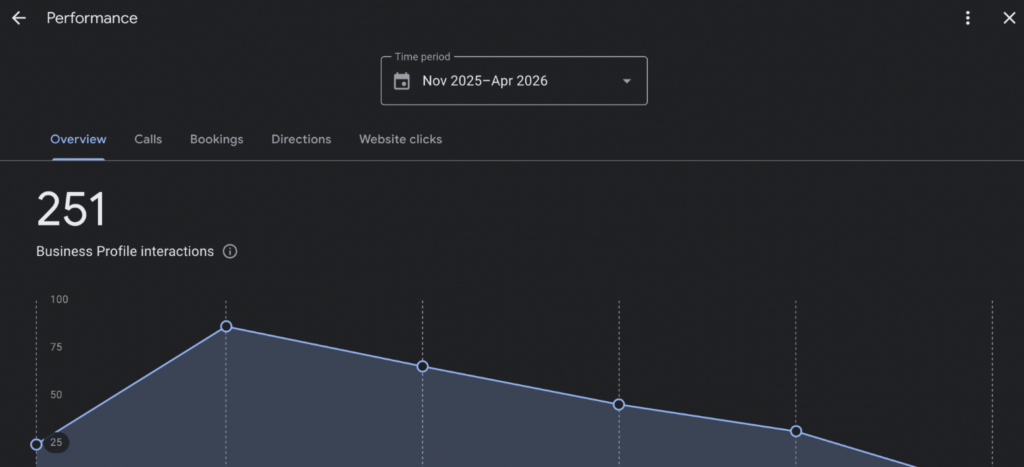
After creating a Google Business Profile, you can track key insights like
- The number of calls made to the phone number listed on your Business Profile.
- The number of bookings made via Google for your business.
- How many people clicked on your business address for Google Maps directions?
- How many people clicked on your website link via the business profile?
Google provides an interactive dashboard to track these insights, and you can filter reports by specific dates. Increased interactions with your Google profile indicate an effective local SEO strategy.
Measuring local website traffic
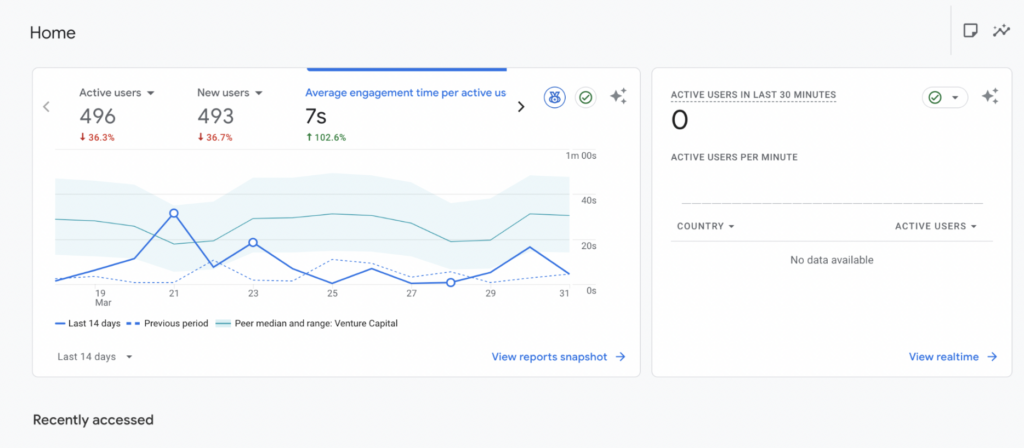
Organic traffic remains a key indicator of your SEO effectiveness. Monitor your website’s traffic from local visitors over time. Increased traffic means you have an effective local SEO strategy that’s attracting eyeballs. Otherwise, you’ll need to adjust your strategy to get the desired results.

Google Analytics is a free tool for website owners to monitor traffic. It shows in-depth traffic insights like location, average time spent on site, average time spent on a specific page, referral source, and bounce rate.
Common local SEO mistakes to avoid
Like with everything, business owners make some common mistakes when implementing local SEO. However, knowing about these mistakes beforehand helps you avoid them. Let’s explore them below:
Inconsistent business information across platforms
A business may have different information across multiple platforms, such as a different email address listed in their Google Business Profile and social media page. While having multiple email addresses may seem normal, this inconsistency creates confusion for potential customers. They can have doubts about which contact information to use and, in some cases, conclude that the business isn’t trustworthy.
To avoid losing trust, always have consistent information across all directories where your business is listed. Use the same phone numbers, email addresses, physical address, and other key information across all directories.
Ignoring customer reviews
Businesses often don’t give feedback on customer reviews, whether positive or negative, but this is a mistake. A lack of feedback gives searchers the impression of a business not caring about its customers’ opinions. It can result in lower search rankings and, consequently, revenue.
Promptly respond to reviews to give the impression of a business caring deeply about its customers’ opinions. As we’ve mentioned earlier, respond to positive reviews in an appreciative manner and negative reviews in a conciliatory tone. Resist the temptation to match negative reviews with negative feedback, as this leaves a bad taste with people viewing your profile.
Let’s see some examples of proper responses to negative reviews:
| Review | Response |
|---|---|
| A disappointed customer who left a 1-star rating. | We’re sorry to hear you didn’t get an ideal experience with our product. We’ve relayed this issue to the relevant department, and be assured we’re working on a quick solution. |
| A restaurant’s customer who complained of poor service. | Hi [customer’s name], we’re sorry that you had that experience. That’s not the kind of service we strive to provide. We’ve addressed this issue with our team, and please feel free to reach out to make things right. |
A customer who got a defective product. | Hi [customer’s name], we’re sorry that the product you bought was defective. We take product quality seriously and would like to correct this mistake. Please reach out to [customer care’s contact] to obtain a replacement. |
Poor optimisation of location pages
Some businesses neglect optimising their location-based pages. They use the exact content across all location pages, merely changing city names. The lack of unique content causes search engines to deem the pages as duplicates and derank them, so this mistake should always be avoided.
Tweak the content for each location-based page, incorporating keywords and slang popular in each location. Each page should have unique meta descriptions, title tags, and schema markup. Include testimonials, FAQs, and other content that make each page unique.
Lack of local backlinks
Failing to get backlinks from local and regional sites is a mistake. For local businesses, Google considers local backlinks a better approval stamp than backlinks from generic sites. A backlink from a local directory, city blog, or a chamber of commerce site can do a lot for your business. Focus on backlinks from local sites to build search authority.
Conclusion
With the right local SEO strategy, attracting foot traffic to your store becomes a cakewalk. With a detailed Google Business Profile, optimised content, local citations, and positive reviews, your business gets set up for long-term success spurred by search traffic.
We’ve outlined the best local SEO practices, the common mistakes to avoid, and how to measure your local SEO performance. Follow these guidelines to take your business to the next level.
If you need help with local SEO efforts, why not work with Why Seo Serious? We offer full-stack SEO services to grow both your online and foot traffic. We are one email away, so contact us today to see how we can help.
Frequently asked questions (FAQs) about local SEO
What’s the difference between local and traditional SEO?
Local SEO prioritises rankings for location-based searches (e.g., “restaurants near me” or “shopping malls in my area”), while traditional SEO prioritises rankings for generic, non-location-based search queries. Local SEO is targeted at a specific radius (city, neighbourhood, or region), while traditional SEO targets broad national and international audiences.
How long does local SEO take to work?
Local SEO efforts generally take 3 to 6 months to show initial results and up to 12 months to deliver the best results. It’s a long-term effort, not a quick-win strategy, so don’t fret if you don’t see the ideal results within weeks– it works on a longer timeframe.
Do I need a website for local SEO?
You don’t necessarily need a website for local SEO, although having one helps. A website provides a central hub for customers to discover important information about your business. It also allows customers to book appointments before heading to your physical location.
How important are reviews for local SEO?
Reviews are very crucial in local SEO. Businesses with positive (4.5+ stars on average) reviews rank higher than those with fewer positive reviews. Reviews build trust with people encountering your business for the first time, encouraging them to try out what you offer.
Is a Google Business Profile necessary for local SEO?
Yes, a Google Business Profile is a necessity for local SEO. It provides a one-stop snippet for customers to discover key information about your business, like phone numbers, email addresses, official website, and physical address. Otherwise, Google may index and display the wrong information to customers. Physical businesses without a Google Business Profile are at a competitive disadvantage.