
Contents
You’ve always heard of keyword research being core to search engine optimisation (SEO), so much so that it has become etched into your mind. Look for SEO advice anywhere, and it’s always recommended to find and incorporate relevant keywords into your site. However, are you aware that there are two types of keywords: short-tail and long-tail?
The summary is that short-tail keywords are broad and contain 1 to 3 words, while long-tail keywords are specific and comprise 3+ words. Think of something like “Best sneakers” vs. “Best waterproof sneakers for winter.” In this guide, we’re diving deep into long-tail keywords, why they matter, and their best practices.
What are long-tail keywords?
Long-tail keywords are highly specific phrases that people search for. They don’t have the largest search volumes, but they have high search intent, with audiences ready to purchase an item. For example, someone who searches for “the best waterproof sneakers in winter” likely wants to buy a waterproof sneaker for themselves. By targeting long-tail keywords, you can attract higher-converting visitors compared to broad short-tail keywords.
Difference between short-tail and long-tail keywords
- Short-tail keywords comprise 1 to 3 words with broad terms. On the other hand, long-tail keywords comprise over 3 words with a very specific purpose.
- Short-tail keywords have higher search volumes, but there’s intense competition for them. In contrast, long-tail keywords have low search volumes, but with less competition, making it easier to rank for them with the right content.
- Long-tail keywords have higher conversion rates because they indicate specific user intent (e.g., buying a product), while short-tail keywords are often too broad to know exactly what the searcher needs.
Examples of long-tail search queries
Here are a few long-tail keyword examples:
- The best blenders for minimalistic kitchens.
- Affordable spas near Brooklyn, NYC.
- Gardening tips for beginners during winter.
- Why are my palm tree leaves turning yellow?
SEO benefits of long-tail keywords
Targeting long-tail keywords has several benefits. For one, there’s lower competition, so you have better chances of hitting the top search results after publishing in-depth content. You don’t have to fight with every website out there seeking to rank for broad keywords. It’s less battle royale and more of a scuffle.
Lower competition and easier rankings
As we’ve said, long-tail keywords have less competition. They are highly specific, so many websites don’t battle for them as they do for broad short-tail keywords. By targeting long-tail keywords, your new website can become a “big fish in a small pond” instead of a “small fish in a big pond” with little chances of rising to the top.
More targeted organic traffic
With long-tail search phrases, your website attracts users seeking exactly what you offer. This translates into better engagement and lower bounce rates. You’ll get those users willing to spend minutes on your content, not those who leave after a few seconds.
Higher conversion potential
To continue our earlier point, long-tail keywords attract visitors who need exactly what you offer. These visitors have high intent, so they’re more likely to purchase your product, click on an affiliate link, or interact with an ad.
For example, someone searching for “late-night taco delivery near me” is likely hungry for some tacos and willing to place an immediate order. Wouldn’t you want to be the top-ranking result so that this customer can order from you?
How to find long-tail keywords
You can find long-tail keywords through manual research or rely on SEO tools like Google’s Search Console and Keyword Planner. For instance, from your Search Console dashboard, you can quickly find low-competition keywords to target in various niches. Let’s explore the methods below.
Using keyword research tools
Given that many of us dread the process of manually researching keywords, people naturally built software that automates the process. You can use keyword research software to automatically find long-tail keywords based on your requirements.
For example, you can enter one word (e.g., “shoes”) and a location (e.g., “U.K.), then automatically find the best long-tail keywords related to shoes for a U.K. audience. Expect results like:
- Waterproof hiking shoes.
- Comfortable work shoes for nurses.
- Stylish Dr Martens shoes.
Many research tools exist, but we’ve curated the best ones for you below.
Google Keyword Planner
Keyword Planner is a free tool offered for Google Ads users. It’s designed to find long-tail keywords for Google ad campaigns. However, you don’t have to run ad campaigns to use the tool. Simply find the long-tail keywords, then use them to optimise your content.
We like the ease of using Keyword Planner: users simply enter their website URL, and Google automatically finds long-tail keywords related to the website’s content. Alternatively, enter a word, and Google identifies long-tail keywords related to it.
Semrush
Semrush offers a Keyword Magic tool that kind of works like magic. You’ll enter a broad ‘seed’ keyword and choose a location. Then, Semrush immediately lists the long-tail keywords related to that seed word and relevant to your selected location.
If you’re a paid Semrush user, you get to filter the keyword results by difficulty and the number of words (e.g., “3 to 5”), but free users don’t have this privilege. Regardless of your tier, Semrush still helps identify the most relevant long-tail keywords to target.
Ahrefs
Ahrefs offers a free Keyword Generator that works just like Semrush’s Keyword Magic tool. You’ll enter a seed word, choose a location, and hit the Find Keywords button. You’ll immediately see a list of long-tail keywords relevant to your seed word and desired location. Paid users can further filter the results by ranking difficulty, word count, traffic potential, global volume, etc.

Analysing competitor keywords
Emulating competitors is an effective way of discovering long-tail keywords. After all, your top competitors got to their level by applying the right keyword strategies. Following their long-tail keywords gives you a good shot of getting higher search rankings.
You can check your competitors’ content manually to figure out their long-tail keywords, but that’ll be too hectic. The convenient way is to use Semrush, Ahrefs, or other SEO tools to analyse your competitors’ sites. These tools sift through your competitors to pinpoint their top long-tail keywords. Then, you can target similar keywords on your site.
Using search suggestions and autocomplete
Google search suggestions give a good hint of long-tail keywords to target. Type something like “Best shoes for…” on Google, and you’ll see autocomplete suggestions like:
- Best shoes for baggy jeans.
- Best shoes for working out.
- Best shoes for flat feet.
Google suggests these long-tail phrases because they are what many people search for. That tells you something important: target these long-tail keywords when creating content, and you can get significant high-intent traffic.
How to rank for long-tail keywords
We’ve discussed the best tools to find long-tail keywords. Now, it’s time to learn how to rank high for the keywords you discovered. Let’s dive deeper below:
Match content to search intent
Match your content exactly to the search intent indicated by a long-tail keyword. For example, someone searching for “best historical romance novels set in London” should get a detailed guide on some of the best romance novels in this setting. List several options, describe what they’re about, and why they qualify as one of the best books in this genre. Users should have their curiosities satisfied after reading your content.
Matching content to search intent not only helps you rank high for long-tail keywords. It also helps your website appear on search engine snippets and voice queries, translating to higher organic traffic.
Use long-tail keywords in on-page SEO
In SEO, long-tail keywords aren’t only incorporated into content bodies. You can insert them in on-page SEO elements like headers (H1, H2, H3, etc.), meta description tags, and alternative text for images. These on-page elements are major contributors to search rankings, so incorporating long-tail keywords raises your chances of hitting the top results.
Natural keyword placement in content
Keywords should be placed naturally and not feel stuffed. Consider these examples:
- Looking for the best historical romance novels set in London? Here’s a list of the best romance novels set in London. We hope you enjoy these fascinating romance novels set in London, a magical, bustling city.
Above, the long-tail keyword is repeated so much that it feels forced. Then, consider this:
- Looking for the best historical romance novels set in London? We’ve curated a list of these novels that take you virtually into the heart of London, a bustling, artistic city. We hope you enjoy these fascinating novels.
Above, the long-tail keyword is mentioned just once and looks naturally inserted. It’s the best option for both readers, who don’t like reading the same phrases over and over again, and search engines, which penalise keyword stuffing.

Create content around specific topics
Create content clusters centered around specific topics. There’ll be a central “pillar topic,” multiple subtopic pages, and internal linking between them to establish topical authority.
For example, your central topic can be The best romance novels of all time. Then, subtopics can be:
- The best historical romance novels set in London.
- The best romance novels set in Paris.
- Must-read classic romance novels.
- Contemporary romance novels set in Singapore.
Each subtopic will have an internal link pointing to the pillar page: The best romance novels of all time. The subtopics will also link to each other. This internal linking indicates your site’s expertise in the topic of romance novels, making search engines more likely to suggest it.

Use internal linking to support rankings
Just above, we illustrated how internal linking helps establish topical authority. It also helps search crawlers index your site properly, as the internal links act like a map pointing crawlers to your in-depth content. Likewise, it encourages users to stay on your site longer. With enough informative content and internal linking pointing to them, a reader might just fall down a rabbit hole on that topic they’re curious about.
Common mistakes when targeting long-tail keywords
No one is perfect, not even the most experienced SEO agency (although hiring one can help significantly). People make mistakes when targeting long-tail keywords, and these mistakes can negatively affect search rankings. Let’s explore the most common mistakes to avoid:
Keyword stuffing
When discussing “natural keyword placement in content” earlier, we illustrated keyword stuffing and why it should be avoided. Firstly, readers can notice keyword stuffing and consider such content not worth scrolling through further. Secondly, search engine algorithms can detect keyword stuffing, and sites found wanting are penalised with lower rankings. Place keywords naturally and avoid the mistake of stuffing them into your content.
Ignoring search intent
Search intent is the crux of creating content. Targeting a long-tail keyword is mostly about creating content that matches the keyword’s intent. For example, a guide on “Why are my plants turning yellow?” should dive deep into the possible reasons for plants turning yellow and provide remedies. This content answers exactly what the user searched for, and it should be so for all topics.
Targeting keywords with too little search demand
We’ve said that long-tail keywords have naturally lower search volumes. Yet, some low-volume keywords may not be worth the effort. If you need to target low-volume keywords, focus on those with high intent, like “buy wheat-free bread with no added sugar” or “best organic food for small puppies with sensitive stomachs.”
How to measure the performance of long-tail keywords
After learning the best long-tail keyword practices and the common mistakes to avoid, it’s time to know how to measure the performance of your long-tail keyword targeting. After all, if you can’t evaluate something accurately, there’s little use putting much effort into it. These are the key metrics to measure:
Tracking keyword rankings
Track your rankings for the long-tail keywords you target. The aim is to rank on the top three results or at least on the front page. How many times have you clicked on the second or third page of Google? That tells you that not ranking in the first page is a major disadvantage.
Semrush and Ahrefs can show your website’s rank for specific keywords. You can monitor rankings daily and compare them with competitors. Outdoing competitors should be the main goal.
Monitoring organic traffic
Monitoring your organic traffic says a lot about the effectiveness of your long-tail keyword targeting efforts. Higher traffic indicates that you’re getting new readers from search engines.
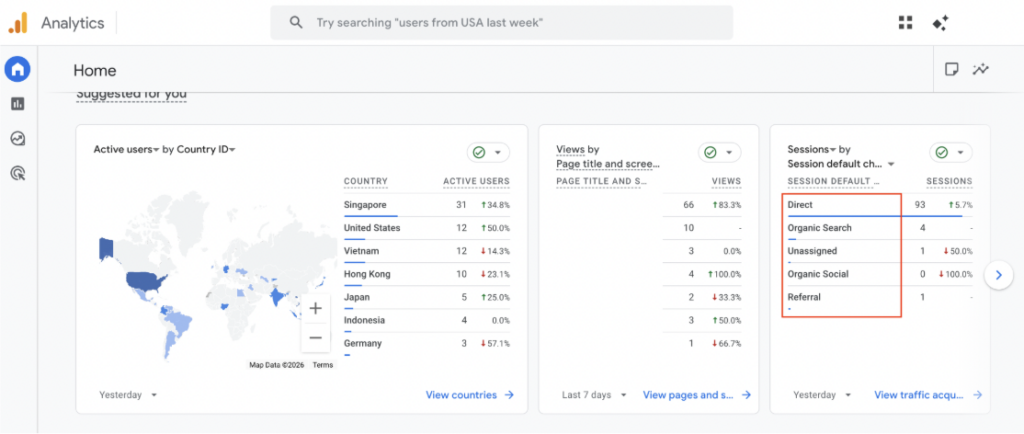
Google Analytics is a free traffic monitoring tool you can use. It displays your organic traffic by source (search engines, social media, etc.), so you’ll always know which traffic originates from Google search and which comes from other sources.
Measuring conversions and engagement
Closely watch your conversions, which represent the percentage of visitors that take a suggested action. It could be the percentage of visitors who:
- Buy a product.
- Click on an ad.
- Click on an affiliate link.
- Subscribe to your email newsletter.
Long-tail keywords are known for their high intent, as people searching for them have specific needs and are willing to take action. An effective long-tail keyword strategy always leads to higher conversion rates.
Conclusion
With what you’ve learned, you should be ready to begin targeting long-tail keywords and boosting search rankings. Every SEO strategy is a long-term process, so expect slower and steady results, not quick-wins. If handling long-tail keywords and other SEO aspects feels strenuous, you can offload it to the experts, like us. At Why SEO Serious, we offer full-stack SEO services, including keyword research and optimisation, for businesses. Contact us today to see how we can help.
Long-tail keywords FAQs
What are long-tail keywords?
Long-tail keywords are highly specific phrases (of 3+ words) that people search for. These keywords have lower search volumes than broad, short-tail keywords, but they have higher conversion rates because they reflect specific user intent. There’s also less competition for long-tail keywords, making it easier for new publishers to compete for eyeballs.
Are long-tail keywords good for SEO?
Yes, long-tail keywords are good for SEO. With the right content, you have better chances of ranking high for less-competitive long-tail keywords than for intensely competitive short-tail keywords.
How many long-tail keywords should you target?
There’s no exact range of long-tail keywords to target. For each page, you can target anywhere from 5 to 50 of them, depending on the page length. Each page should be centered on one primary long-tail keyword, then with secondary long-tail keywords that supplement the primary one.
Can long-tail keywords increase conversions?
Yes, implementing the recommended long-tail keyword practices always leads to increased conversions. It attracts a high-intent audience that is more willing to take suggested actions, compared to people searching for short-tail keywords.