
Contents
What is B2B SEO and how it drives business growth
A corporate decision maker follows a different search pattern than an everyday consumer. While everyday users search for broad terms like “restaurants near me” and “24/7 pharmacies,” corporate decision makers search for highly specific terms like “ERP software for healthcare organisations.”
SEO for business-to-business (B2B) firms, targeted at key decision makers, requires a different approach than typical SEO. In this case, you’re targeting people who carefully scrutinise content like a scientist with a magnifying glass. Ahead is a guide on B2B SEO, its best strategies, and the key strategies for attracting business decision makers to your website.
Understanding B2B SEO: Core concepts
B2B SEO is all about optimising your website to attract enterprise customers through search engines. It revolves around creating content that appeals to your ideal corporate target audience, then adopting strategies that make the content rank high on search engine results pages (SERPs).
How B2B SEO differs from B2C
Some core concepts that separate B2B from business-to-consumer (B2C) SEO are:
- Targeting high-intent, low-volume keywords. Corporate decision makers search for specific, solution-oriented keywords (e.g., “Cloud-based software for e-commerce logistics). These keywords may not have high search volumes, but they have strong purchasing intent.
- Long-term approach. Business purchasing decisions aren’t made on a whim. They require deliberate, extensive research and input from multiple stakeholders. Hence, a B2B SEO strategy requires creating content for several purchasing stages: educational (creating awareness for a product), consideration (comparing the product with other alternatives), and decision (validating the product).
The role of SEO in generating qualified leads
Effective SEO attracts high-intent searchers to your website, and these searchers are potential customers seeking to make corporate purchasing decisions. If they encounter valuable content with compelling calls-to-action (CTAs) on a website, they’ll likely fill out the contact form or book a consultation to get more information. With the right SEO strategy, businesses can convert a sizable percentage of visitors into qualified leads. Those visitors can quickly start contacting you to discuss big deals.
Why B2B SEO matters more than ever
Most B2B buyers research solutions online before contacting sales teams. B2B SEO positions your content to reach these high-intent buyers. It increases brand visibility among key corporate decision makers, translating to a higher chance of selling your product.
In competitive industries, particularly enterprise software, B2B SEO isn’t optional. It helps build lasting authority that you can rely on to attract customers. Paid ads drive conversions, but the conversions go away when you stop paying. Effective SEO, on the other hand, drives long-term conversions at little to no cost. You don’t have to spend all your marketing dollars chasing organic traffic.
Staying competitive in a complex digital landscape
To stay competitive, businesses should shift from “volume-first” to “high-intent-driven” SEO strategies. It isn’t about the search volumes, but rather about the search intent. The best keywords to target may have low search volumes, but people searching for these keywords have indicated their status as potential customers. Prioritising high-intent, long-tail keywords is the main aspect of a competitive B2B SEO strategy.
Also, focus on creating content that demonstrates Experience, Expertise, Authoritativeness, and Trustworthiness (E-E-A-T). Google uses the E-E-A-T framework to evaluate content quality, and sites with higher scores are prioritised over the rest.
Integrating SEO with marketing and sales strategies
To get the best results, SEO strategies should be aligned with a business’s marketing and sales strategies. For example, you can use sales team insights to determine what features customers want in a product, then create optimised content discussing these features. Website blog posts can be aligned with social media content uploaded by the marketing team.
The SEO team should ensure the website meets technical SEO standards (fast speeds and mobile-friendliness), as this also helps sales teams get leads. B2B SEO doesn’t work alone. Instead, it delivers the best results when aligned with general business marketing strategies.
Advanced B2B SEO strategies
Effective B2B SEO requires implementing key strategies to capture high-intent traffic. These strategies span keyword research, technical SEO optimisation, amassing backlinks, and creating high-quality content. Let’s explore them below:
Strategic keyword research for B2B markets
Optimisation starts with researching the right high-intent, long-tail keywords to create content for. Your focus should be on the search phrases used by corporate decision-makers, not generic industry search terms. For example, you can collaborate with sales teams to analyze call recordings, then note the common pain points mentioned by leads. Then, these pain points can be transformed into search queries, e.g., “third-party logistics software with multi-warehouse visibility.”
However, to make things easier, businesses can use SEO tools like Semrush and Ahrefs to identify long-tail keywords. These tools have vast keyword databases, from which they suggest long-tail keywords based on unique factors (like word count, difficulty, and intent). They help SEO professionals quickly find the right keywords to target, rather than go through longer manual processes.
Technical SEO optimisation for site performance and indexing
B2B SEO is as technical as it is about creating high-quality content targeting the right keywords. A website’s backend infrastructure (speed, mobile-friendliness, and crawlability) needs to be in the best shape to enable it to rank high on search engines. You don’t want to have a website that takes so long to load that users could handle a few chores before finally seeing the content.
- Speed. A website should completely load under 2.5 seconds to provide a good user experience. Google prioritises fast sites over slower ones. To ensure faster speeds, compress images, videos, and other visual elements to the smallest possible sizes.
- Mobile-friendliness. A website’s elements should automatically be adjusted for smaller mobile screens. The content should be legible, highly visible, and easy to scroll through on smartphones and tablets. Mobile devices constitute 60% of online traffic, so create content for mobile devices first, not desktops.
- Crawlability. Upload a detailed sitemap.xml file to Google Search Console; this sitemap provides a roadmap for search engine crawlers to properly index a website. Also, optimise your robots.txt file to instruct crawlers about which pages to index and which to avoid. Otherwise, search crawlers could index irrelevant content and overuse their crawl budget for little gain.
- Fix technical issues. Scan your website for technical issues like 404 error pages, duplicate content, and broken links. Then, fix these issues immediately to prevent search crawlers from hitting dead ends during indexing.
Google provides a free PageSpeed Insights tool to evaluate a website’s speed and mobile-friendliness. It also provides a free Search Console tool where site owners can submit sitemaps, conduct technical audits, and learn which keywords attract the most traffic.
Creating authoritative and industry-focused content
You need to create authoritative content around the high-intent keywords identified during the research stage. Authoritative content has these characteristics:
- It demonstrates first-hand knowledge of the topic being discussed, with relatable examples provided for the reader. For example, an article about “Third-party logistics software with multi-warehouse visibility” will include an example outlining how this software helps logistics companies keep tabs on their operations.
- It provides original insights instead of rehashing generic information. Offer a unique perspective, even if it may challenge industry consensus, and talk about new industry trends. The content should provide the reader with data and insights to think about.
- It incorporates visuals, like images, videos, and infographics, to provide context. No one likes reading endless blocks of text without occasional images that add more context.
- Figures and statistics are properly cited. That way, readers will be sure the figures weren’t pulled out of thin air– they’ll follow the citations to confirm for themselves.
- The best articles are written from a problem-solving perspective. They respond exactly to the problem the reader searches for.
Content that fits the above characteristics is rewarded by search engine algorithms, leading to increased visibility for a high-intent audience.
Building a high-quality and relevant backlink profile
Backlinks are hyperlinks from other websites to yours. They are akin to “votes of confidence” in your content, signaling to search engines that you provide high-quality content people direct their audiences to. Think of them like a tap on the back from your buddies, telling everyone that you’re in the clique.
Target high-traffic sites in related niches for backlinks, not generic sites. For example, a gaming blog should prioritise backlinks from high-traffic gaming sites. The best way to get backlinks is by posting informative content that people will naturally link to. You can also participate in backlink exchanges with similar sites.
Avoid dealing with spammy, unrelated sites, as Google penalises websites found trying to game the backlink system. Link quality matters more than quantity, so target backlinks from reputable publications and industry experts.
On-page SEO optimisation for better engagement and conversions
On-page SEO deals with adjusting on-page elements to get higher search rankings and audience engagement. It covers:
- Creating a title tag and meta description for each page, indicated in the HTML source code. Title tags should be under 60 characters, and meta descriptions should be under 160 characters. The former defines what the webpage is about, and the latter provides a short summary of the page. They both appear in search engine results, so use compelling descriptions to convince people to click on your site.
- Separate pages with proper headings. There should be one H1 tag, then H2s, H3s, H4s, etc., to indicate the content hierarchy. Proper headings improve readability and help users navigate content conveniently.
- Keep URL structures short and descriptive. Example.com/guide-to-seo is much better than Example.com/a-guide-to-seo-how-it-works-and-best-practices.
- Add the primary keyword naturally in the first 100 words of a page. Then, incorporate other keywords into different parts of a page. They should sound natural rather than forced. Search engines penalise forced keyword stuffing, so it should be avoided.
- Add alternative “alt” text to all images. Search engines rely on alt text to understand what images are about and suggest them to the right users.
- On each article or page, add internal links to other relevant pages of your website. Internal links boost search authority and keep readers on your website for longer periods.
- Use schema markup code to help search engines understand your content. For example, you can use schema markup to define a “Frequently Asked Questions (FAQs)” section, and search engines will properly index and suggest the content to the right audience.
- Pages should be optimised to load fast, as speed is a major search ranking factor.
Measuring B2B SEO success
You’ve learned the B2B SEO best practices. Now, it’s time to learn how to measure the success of your strategies and make timely adjustments when called for. Let’s cover the key methods below:
Tracking organic traffic and lead conversions
The ultimate goal of B2B SEO is to attract organic (unpaid) traffic that’ll translate into valuable business leads. Hence, the primary metric to measure success is the increase in organic traffic over time. Also, closely watch your conversion rate, which represents the percentage of visitors that convert into leads.
Google provides a free Analytics tool that enables easy traffic monitoring. With this tool, website owners can view their exact number of visitors, the location of each visitor, and the traffic source. It shows crucial metrics like the average time visitors spend on your site, the number of returning visitors, and the average time spent on specific pages. You can find both real-time and historical data on Google Analytics.
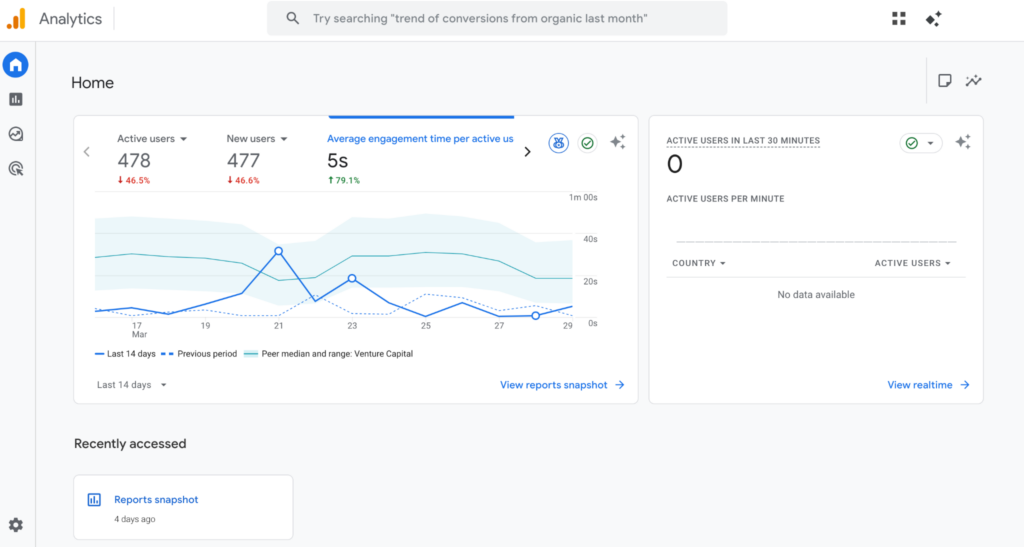
SEO efforts can take 3 to 12 months to show concrete results, so don’t expect an immediate organic traffic increase. B2B SEO is a long-term bet, so monitor your organic traffic over several months to know if you’ve implemented the right strategies. The process might take longer than your commute during rush hour, but you need to endure.
Monitoring rankings, visibility, and SERP features
Monitor your website rankings for targeted keywords. Semrush, Ahrefs, Google Search Console, and similar SEO tools make monitoring search rankings easy. The aim is to get the highest rankings and outdo competitors. Compare current rankings to previous results and ensure there’s an improvement. Otherwise, it’s a signal to adjust your B2B SEO strategies to get better results.
Check your website’s visibility score, which denotes the percentage of clicks received based on its rankings. This score provides a more complete picture of SEO performance.
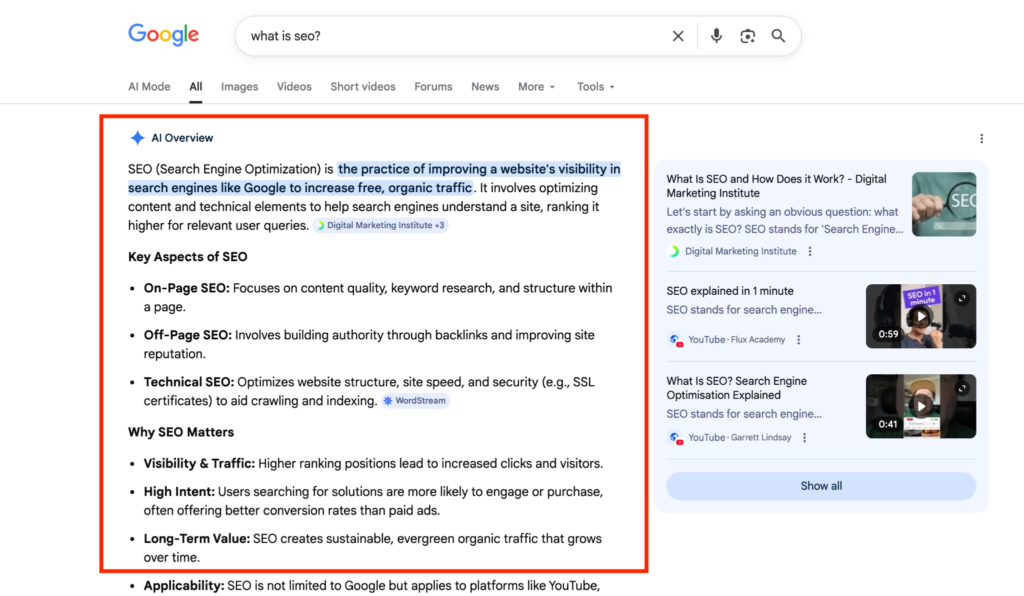
Likewise, monitor how often your site appears in search engine features like AI overviews, rich snippets, and local packs (for businesses with physical retail outlets).
AI overviews. These are AI-generated summaries displayed at the top of search results. Websites that get cited in an overview receive more clicks.

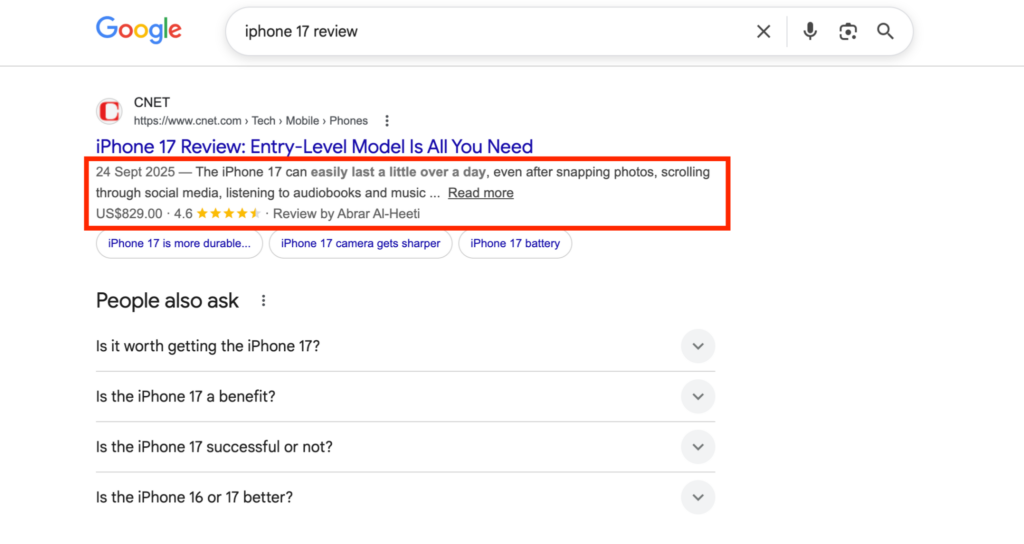
Rich snippets. These are visually enhanced search results that display key data like prices, review ratings, and images. This data is sourced from schema markup, highlighting the importance of website elements with schema markup code.
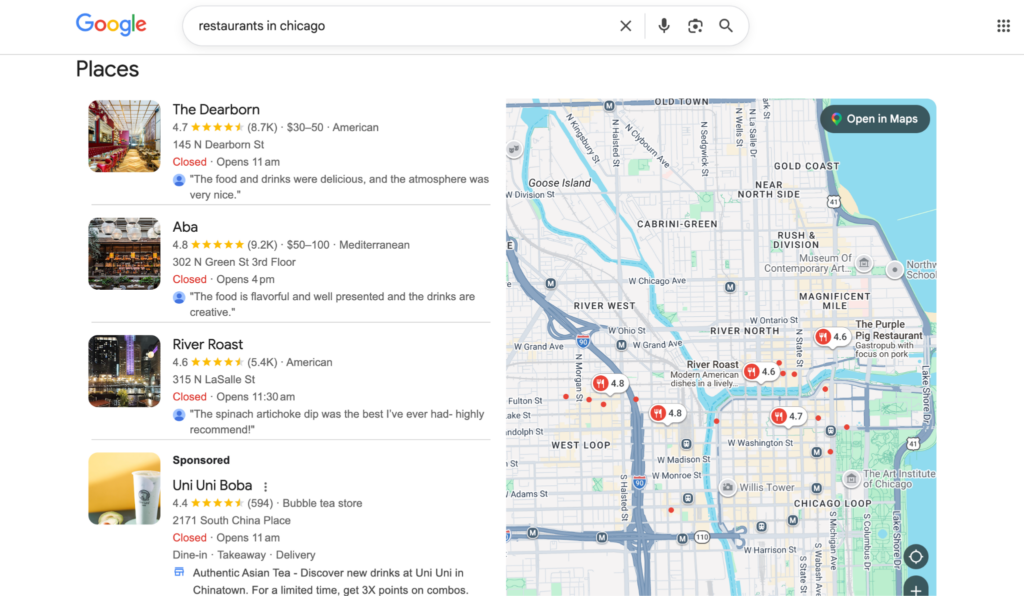
Local packs. A prominent Google feature that displays a map and the top three local businesses for location-based search queries. For example, if someone searches for “restaurants in Chicago,” Google displays the top three results of restaurants in this region. Entering the top-three works wonders for a business.
Conducting comprehensive SEO audits
Conduct extensive SEO audits on your website at least twice a year. This audit is a thorough evaluation of your site’s technical and on-page SEO attributes, ensuring they follow the recommended best practices. Things to audit include:
Technical
- Crawl errors. Use tools like Screaming Frog’s SEO Spider to detect errors preventing your site from being crawled properly, then fix these issues promptly.
- Core Web Vitals. Use Google’s free PageSpeed Insights tool to check your site’s Core Web Vitals, which revolves around loading speed (Largest Contentful Paint, or LCP), user interaction speed (Interaction to Next Paint, or INP), and how often content unexpectedly shifts around a user’s screen (Cumulative Layout Shift, or CLS). If the vitals aren’t in line with Google’s standards, edit your website to bring them up to standard, as Google prioritises sites with good Core Web Vitals scores.
- XML sitemap. Upload an updated XML sitemap after adding substantial new content or changing your website structure. Also, check your robots.txt file for any errors preventing search crawlers from indexing the right pages, then correct them.
On-page
- Duplicate content. Identify and remove duplicate content across your site. Otherwise, crawlers will waste their budget indexing the same content repeatedly and neglect some other relevant pages.
- Meta elements. Review all pages and ensure they all have proper title and meta description tags.
- URL structure. Simplify bulky URL structures and make them shorter. Example.com/one-two-three-four is a good template, not Example.com/this-information-is-too-long-and-unnecessary-123-456.
- Content updates. Add new information and correct outdated figures across your content. Up-to-date content keeps readers engaged on your site.
- Google My Business profile. If you run a location-based business, ensure your Google My Business profile is up-to-date and has the right contact information. Google prominently displays this profile when someone searches for your business, so having a complete profile helps attract customers. You don’t want a customer calling the wrong number and getting yelled at by a stranger.
You don’t have to audit an entire website manually, although some manual checks still help. SEO tools like Semrush, Google Search Console, Ahrefs, and others can scan sites to automatically detect errors that should be fixed. It’s like having a magic wand to wave and point out all your SEO problems.
Make SEO work for sales
We’ll map how your buyers search, where competitors win and what your site needs to capture qualified traffic.
Overcoming common B2B SEO challenges
Handling SEO for B2B companies has its challenges. Sales cycles are longer compared to B2C SEO, and you’ll mainly work with low-volume but high-intent keywords, not the high-volume keywords used in B2C SEO. Adjusting to these differences can be challenging, so let’s explore how to overcome them:
Working with low-volume but high-intent keywords
Niche B2B products often have low search volumes, yet attract significant leads. In B2B SEO, you have to get comfortable with working with low-volume keywords and focusing on intent over search volumes. Focus on long-tail keywords, which are highly specific phrases with 3 or more words and have clear commercial intent.
Analyse sales support tickets to know what customers often complain about, then convert these problems into precise long-tail keywords. Use SEO tools like Semrush to identify long-tail keywords in your niche and competitive content gaps to fill. Mine social media sites and online forums to discover the exact phrasing corporate buyers use, then create specialized, in-depth content around this information.
Managing limited content resources effectively
Resources for creating content are often limited. You can counter this challenge with a strategic approach that prioritises quality over quantity. For example, you may not have the resources to write many articles, but the few should be informative and optimised enough to reach the exact target audience.
Earlier, we outlined what constitutes high-quality content, from providing original insights to demonstrating first-hand experience, incorporating visuals, citing sources for key figures, and being written from a problem-solving perspective.
Instead of writing fragmented blog posts, organize them around specific topics to build search engine authority.
For example, you can write a deep dive on “A complete guide to third-party logistics.” Then, you’ll write smaller articles like “Managing multiple warehouses with 3PL software” and “Processing cross-border returns through 3PL software.” The smaller articles will link back to the pillar “A complete guide to third-party logistics” article. This cluster model demonstrates expertise and authority to search engines.
Competing in highly saturated niches
Some B2B niches are highly competitive, with too many companies vying for the same target audience. For example, logistics is an intensely competitive sector, where you and 1 million others contest for attention from corporate decision-makers.
In competitive niches, you’ll need to stand out by providing high-quality content. Explain topics in a way that’s informative and engaging. For example, you can write a guide that breaks down the complexities of third-party logistics for an everyday audience, or a guide comparing prices and services between various third-party logistics providers. Content should be written from a problem-solving perspective and demonstrate real expertise with the topic.
Build backlinks from industry-specific sites to stand out in competitive niches. Use SEO tools to analyse content gaps, then create informative content that fills in these gaps.
Conclusion
With the right B2B SEO strategy, you wouldn’t need much else to get that CEO, CFO, or President to seek your services. You’d be surprised who scours through search engines looking for solutions, arrives at your site, and is willing to negotiate large business deals just from observing your online presence. B2B SEO is an undisputed competitive advantage, and this guide has outlined how it works.
You can handle B2B SEO yourself or work with a professional agency. Professional agencies apply their expertise and experience to create the right strategies, saving you a lot of headaches. At Why SEO Serious, we offer full-stack B2B SEO services, so contact us to see how we can help you.