
Contents
How To Outsource SEO
Hiring an in-house SEO team can be daunting, particularly finding the right talent and nurturing them, so you’re probably considering outsourcing SEO to a professional agency. That makes sense, as SEO agencies provide immediate access to expertise required to elevate search rankings.
Yet, how do you find the best agencies? What are the pros and cons of outsourcing SEO compared to doing it in-house, and what tips do you need to pick the right SEO partner? We’ve created this guide to answer these questions and help you make the best choice. Read on to begin your journey towards choosing a productive SEO partner.
What is SEO outsourcing?
SEO outsourcing means relying on external professionals for search engine optimisation efforts, including keyword research, content creation, link building, competitive analysis, and technical audits. These key tasks are handed to external professionals instead of hiring an in-house team. SEO responsibilities are given to specialised teams with the right experience and expertise.
Why companies outsource SEO
Companies outsource SEO to:
- Save costs. Enlisting a professional agency is usually more affordable than hiring in-house SEO experts.
- Gain access to broad SEO skills. An agency provides immediate access to experts in technical optimisation, content creation, backlink building, keyword research, and other SEO aspects. If building an in-house team, finding talent in each area can take a long time.
- Unlock access to premium tools. Premium SEO tools like Semrush, Screaming Frog, and Ahrefs can cost thousands of dollars in annual subscription fees. SEO agencies already have access to these tools, so the company wouldn’t need to pay for them again.
- Time savings. Outsourcing SEO lets companies focus on their core business while experts run the process of elevating search rankings.
SEO outsourcing options
You’ve decided to outsource SEO, but what exact options do you have? You can either hire a full-fledged agency, consultants, or freelancers. Each option has different cost structures and depth of service. Let’s examine them:
Freelancers
You can hire freelancers as needed to run specific aspects of your SEO strategy. For example, you can hire skilled writers to create content for your business blog, or experts to comprehensively audit your website for technical SEO issues.
Freelancers are cost-effective compared to hiring a full agency, but the depth of service is lower. They are hired for specific tasks and fulfill only those. Also, because freelancers work with multiple clients, they may not be available during some periods when you need them.
SEO agencies
An agency provides experts who handle all SEO efforts, from researching keywords to creating content, optimising a Google Business Profile, analysing competitors’ strategies, and more. These experts create and implement a comprehensive SEO strategy for your business, then monitor results over time. This comprehensive service comes at a higher cost, but is usually worthwhile in the long run.
SEO consultants
SEO consultants are senior experts who give professional advice on building your SEO strategy. They offer guidance and help oversee strategy implementation, but they aren’t the ones executing the process. Consultants work with in-house teams or outsourced SEO experts to ensure the strategy is well implemented.
In-house vs. Outsourced SEO
How does in-house SEO compare to outsourcing SEO services in key areas like cost, control, and scalability? This table provides a summary:
| In-house SEO | Outsourced SEO | |
| Cost | Hiring and training in-house SEO experts incurs higher costs. | Outsourced SEO is cost-efficient because the agency has already set up the proper infrastructure, and you pay for regular access. |
| Control | In-house SEO provides more control over your SEO strategy. | Outsourced SEO provides less control compared to an in-house team. |
| Scalability | It’s more difficult to scale because of the need for additional talent and software tools. | Easier to scale because SEO firms provide immediate access to talent and software tools. |
What SEO services can you outsource?
Virtually every SEO task can be outsourced, but this doesn’t mean everything should be. The key is understanding which processes can be handled internally, based on available talent and resources, and which will be handed to external professionals. Let’s see which parts are often outsourced:
On-page SEO
On-page SEO involves
- Adding meta descriptions and title tags to every page.
- Ensuring content hierarchy with H1, H2, and H3 tags, making content easier for search engine crawlers to follow.
- Creating a coherent content structure that readers can easily follow.
- Adding internal links for easier user navigation and search indexing.

Companies often delegate these foundational on-page SEO tasks to external specialists.
Off-page SEO and link building
Off-page SEO centers on efforts taken outside your website to boost its search rankings, like getting backlinks from other sites. It’s the most commonly outsourced SEO effort because of the need for specialised outreach skills. Few companies want to spend the time pitching to website owners for guest posts, features, and links, so this task is often handed to third parties.
Technical SEO
Technical SEO focuses on
- Optimising your website to be mobile-friendly.
- Adjusting your website for faster loading times.
- Using schema markup (structured data) to label key details, making them easier for search engine bots to find.
- Adding a sitemap.XML file that search engine crawlers use as a guide for your website.
- Adding a robots.txt file telling search engine bots which pages to index and which not to.
Companies often outsource technical SEO tasks to third parties because of their complexity.

Content marketing
Writing in-depth, valuable posts to attract readers is frequently handed to professional agencies. An in-house team could be in charge of setting the content strategy, but execution is often outsourced to agencies with deep content creation expertise. Specialised writers, graphic designers, and editors collaborate to create valuable content that’ll attract organic traffic to the client’s website.
Note: Some agencies churn out AI text without an editor or expert reviewing them. In 2026, this is risky: Google punishes websites filled with AI slop lacking human review.
Local SEO
Local SEO involves
- Creating a detailed Google Business Profile for a physical business. This profile lets searchers easily find a company’s location, phone number, menu, price range, and opening hours.
- Getting citations from local directories, blogs, and websites.
- Responding to reviews on a company’s Google Business Profile.
- Adding schema markup to indicate location-specific information on a website.
These SEO efforts are often given to third parties, freeing up time for companies to focus on running their core business.

E-commerce SEO
E-commerce companies often outsource
- Optimising product pages with title and meta description tags, alt text, and high-quality images.
- Building a hierarchical page structure that’s easy to understand.
- Creating categories and subcategories to enable easier product navigation.
- Adding schema markup code to highlight key product details like price, size, description, and currency.
These tasks can get technical, so companies often outsource them to specialised e-commerce SEO agencies.
International SEO
International SEO covers tasks that help a website rank high across multiple countries and languages, including
- Adding hreflang attributes to tell search engines the language and regional target of distinct web pages.
- Performing keyword research for different languages and markets.
- Adapting content to fit local customer needs.
- Preventing duplicate content across pages for similar markets.
- Avoiding wrong auto-redirects based on IP addresses.
International SEO services are usually sought by companies operating in multiple countries and needing a specialised SEO strategy for each market. For example, a retail chain with outlets in 5 countries needs distinct SEO strategies for each country to achieve better outcomes compared to a generic strategy for all locations.
Benefits of outsourcing SEO
What benefits do companies get from outsourcing SEO services? After all, they’ll hardly do it if they don’t see some rewards. These are the main benefits:
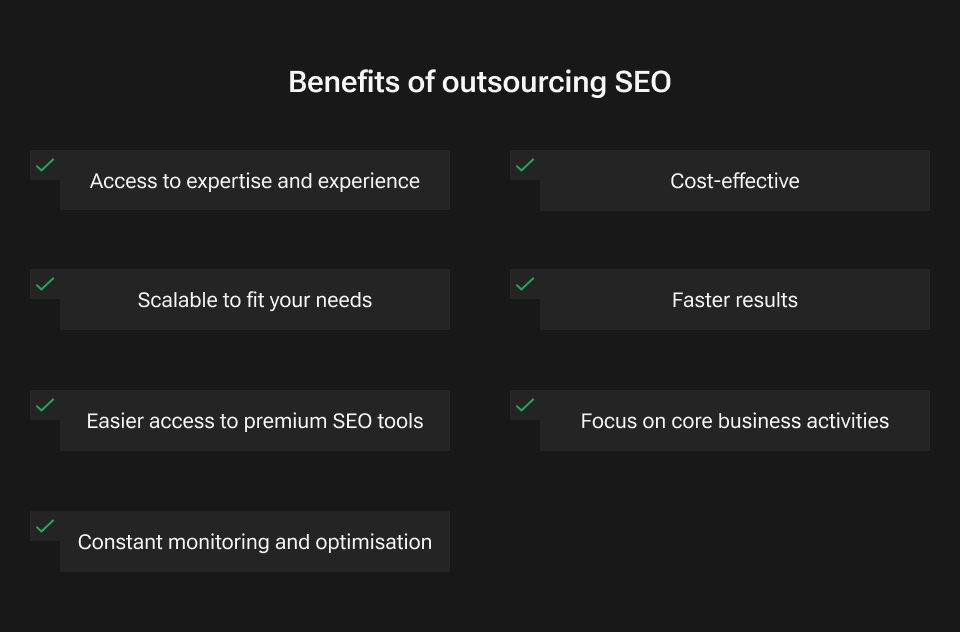
Access to expertise and experience
SEO agencies work across different niches, building in-depth experience and expertise they can apply to your website. They’ve learned the best practices for elevating search rankings, and you’ll get immediate access to this expertise instead of figuring things out from scratch.
Cost-effective
Outsourced SEO is more affordable compared to an in-house team, particularly for small and medium-sized businesses. You’ll only pay for delivered work, with invoices clearly stating what you’re paying for, not idle time as often happens with an in-house team. In-house SEO is best used by large businesses that require a lot of recurring SEO work and have adequate budgets for hiring experts.
Scalable to fit your needs
With outsourced SEO, you can request more resources during peak seasons like product launches and holiday sales, then scale down during slower periods. Agencies have professionals readily available to meet increasing needs, and you’ll only pay for the services rendered.
Faster results
Outsourced teams hit the ground running, already possessing the knowledge, software tools, and experience required to implement an effective SEO strategy. They deliver faster than in-house teams, which take more time to train and onboard before working on your SEO strategy.
Access to premium SEO tools
Agencies pay steep amounts for a suite of SEO tools like Semrush, Ahrefs, Majestic, Screaming Frog, and SEOptimer. These tools help them handle all SEO aspects, from keyword research to creating content and monitoring search rankings. If you were to run an in-house team, you’d pay significant subscription fees for these tools, but by hiring an agency that already has access, the cost is reduced.
Focus on core business activities
When you outsource SEO services, there’s more time to focus on core business activities while external professionals handle search optimisation. This benefit matters more for small and medium-sized businesses with limited budgets.
Constant monitoring and optimisation
Agencies don’t just implement your SEO strategy. They constantly monitor organic traffic, keyword rankings, click-through rates, and other SEO metrics, ensuring the implementation delivers the right results. If not, they adjust the strategy accordingly. With outsourced SEO, you’re sure of the key success factors being monitored daily and weekly, not occasionally.
Challenges and risks of outsourcing SEO
You’ve seen the benefits of outsourced SEO, but there are also challenges that need to be managed. Knowing these risks helps you choose the right SEO partner and build an effective strategy. They include:
Quality and consistency issues
Not all SEO agencies and consultants deliver consistent quality. You could work with a consultant today who delivers excellent results, but the next delivers average or even subpar results. This fluctuation in quality affects your website’s SEO performance, so it’s advisable to work with an experienced agency in the long-term to avoid inconsistency.
Black Hat SEO techniques
Some SEO professionals resort to dodgy “Black Hat” techniques like keyword stuffing, link spamming on forums, and sneaky redirects. Search engines penalise sites engaging in these tactics, but the professional may have gone by then. To avoid this risk, choose a reputable SEO agency with a strong track record, like Why SEO Serious.
Communication and coordination
Communication friction can occur when working with third parties. Language barriers and distant time zones can create friction between your company and the external SEO agency, leading to incorrect work. Choosing an agency that operates in a similar time zone and language helps avoid this risk.
Integration with internal teams
Pairing external professionals with in-house development and marketing teams can get complex, often due to conflicting work processes. For example, an agency could recommend critical technical website fixes, but your internal development team may ignore the ticket because they report to a different manager.
To mitigate this risk, introduce the external SEO agency to your in-house team members and ensure everyone is on the same page. Set clear communication channels, with the agency’s experts knowing who to contact to get key processes implemented.
Measuring ROI and performance
Directly attributing revenue boosts to outsourced SEO efforts is often difficult, despite this attribution being needed to justify the outsourcing spend. For instance, knowing which sales boosts came from SEO and which came from social media and email marketing campaigns can be challenging. Yet, external SEO professionals can still prepare thorough reports outlining their impacts on your bottom line, so request these reports from time to time.

Knowledge transfer risks
When you stop working with an agency, the knowledge accrued over time leaves with the agency, and transferring this knowledge to in-house teams or another external team isn’t easy. That’s why we advise external SEO professionals working closely with in-house teams, ensuring knowledge gets passed and isn’t lost if the agency steps aside.
How to outsource SEO: Step-by-step guide
You’ve weighed the pros and cons of SEO outsourcing and want to proceed with it. How then do you go about it? This step-by-step approach is the most effective way:
Step 1: Define clear SEO goals and KPIs
Start by defining what exactly you want to achieve from SEO, then set key performance indicators (KPIs) to measure the achievements. For example, if you run an e-commerce business seeking improved sales, the ideal KPIs will be revenue and conversion rates.
Step 2: Determine your budget
SEO professionals work with flexible budgets based on your business needs. For instance, freelancers cost less than full-fledged agencies. Set a firm budget range, as this determines the type of service you’ll seek.
Here’s a sample price list you could plan a budget around:
| Service | Price |
| Content creation: Blog posts | $100 to $500 each, based on the length. |
| Local SEO | $1,000 to $2,500 per month |
| One-time detailed SEO audit | $500 |
| On-page SEO | $1,000 per month |
| Technical SEO | $1,500 per month |
The above is just an example, as outsourced SEO prices vary widely based on niche, content volume, and your preferences. What matters is setting a budget and sticking to it.
Step 3: Research and shortlist SEO partners
Check for the SEO agencies and freelancers available in your niche, evaluate their terms, and shortlist the best ones based on your preferences. To find the best agencies, you can check industry forums and ask your professional network. Look for industry experience, positive client reviews, and verifiable case studies when shortlisting the best 3 to 5 options.
Step 4: Evaluate potential partners
Closely evaluate the shortlisted SEO firms, consultants, or freelancers. Look beyond sales pitches and examine reviews from previous clients. Ask in-depth questions like which strategies they use, what they’ll deliver for your brand, and the projected timeline for SEO efforts to yield results.
You’re not just selecting for honesty but also competence. Ask the SEO firm specific questions about AI visibility and their compliance with Google’s Experience, Expertise, Authoritativeness, and Trustworthiness (EEAT) standards. You can ask other questions like
- How do you approach keyword research?
- What’s your process for the initial on-page and technical SEO audit?
- How can you align your SEO strategy with our business goals?
- Do you write new content from scratch, optimize existing content, or only give recommendations?
- What SEO tools do you use?
- How often would we meet to discuss SEO progress and clarify discrepancies?
- How long do you estimate it’ll take to see effective results from SEO efforts?
Step 5: Define the Scope of Work (SOW)
Contact your preferred SEO agency, freelancer, or consultant and create a Scope of Work, a contractual document stating which services you need, deliverables, timelines, payment terms, and acceptance criteria.
Step 6: Set clear expectations and reporting
Set firm expectations on what you expect the SEO professionals to do for you. Define which KPIs will be monitored, how often you’ll need performance reports (e.g., weekly, bi-weekly, or monthly), the schedule of meetings, and how identified SEO issues will be resolved.
Step 7: Provide necessary access
SEO professionals may need to access several internal tools, like your Google Analytics and Google Search Console dashboards, your website’s content management systems (CMS), and web hosting panel. You don’t have to provide complete access: these tools let you provide access with restrictions on what external users can do.
Step 8: Establish communication and check-ins
Establish a schedule where you’ll check in with the SEO professionals and stay updated on their progress. Regular check-ins (such as weekly status calls, monthly updates, and bi-weekly videoconferences) ensure that your company and the SEO experts stay aligned.
Step 9: Monitor performance and track results
Track the performance of the SEO efforts, focusing on the KPIs established in the first step. Whether organic traffic, conversion rates, impressions, click-through rates, keyword rankings, and backlink growth, closely monitor the results and let the SEO experts know whether you’re comfortable with what you see.
Step 10: Fine-tune and adjust when needed
After reviewing the performance, don’t hesitate to adjust strategies to get better results. The experts can always go back to the drawing board to tweak some techniques and aim for better results. There’s no perfect SEO strategy. Sometimes, things don’t work as expected, but that shouldn’t be a showstopper. There’s always room for improvement.
Red flags when choosing an SEO partner
They say all that glitters isn’t gold, and that quote remains valuable in the SEO industry. When seeking potential SEO partners, businesses can encounter SEO service providers that overpromise and underdeliver, or engage in dodgy practices that dent rankings in the long run, not raise them. Here are some red flags to watch out for and avoid such risks:
Guarantees #1 rankings
Any SEO agency guaranteeing number one search rankings isn’t being honest. Too many factors affect search rankings, including algorithm changes, content, and keyword relevance, for anyone to guarantee a top spot. Of course, outsourced SEO requires the team to try their best to hit the top rankings, but there’s no guarantee of becoming number one.
Extremely low prices
You likely want affordable SEO services, but some prices are too low to be true. Avoid SEO professionals promising their services for pennies compared to the norm. SEO requires significant labor, software tools, and expertise to do properly, and companies pricing too low are usually cutting corners around these requirements. For instance, offering full-fledged SEO services for $50 a month isn’t a good signal.
Lack of transparency
The right SEO professionals are always transparent about the services they offer. Avoid SEO agencies that refuse to explain their methods and share regular reports on the optimisation progress. They’re likely hiding some dodgy practices they don’t want you to know, and these practices can sink search rankings in the long run.
No case studies or references
SEO firms without case studies and references from other clients warrant a double-take. A lack of proven results often suggests inexperience or a poor performance history the firm doesn’t want to show. To get the best results, seek experienced firms with a good track record proven by client testimonials and case studies.
Uses Black Hat techniques
We mentioned Black Hat techniques earlier, where some SEO firms use dubious practices like keyword stuffing, cloaking, hidden text, and link spamming on online forums. Such firms should be avoided, as Google penalises sites found engaging in such practices: they may produce results in the short-term, but low rankings abound in the long-term. Always inquire about an SEO firm’s techniques, particularly how they acquire backlinks, before agreeing to work with them.
Vague about their process
As we’ve emphasised, vagueness is a warning sign from an SEO firm. The best SEO professionals are transparent about their services and techniques and don’t give hazy answers. You should know the fundamentals of what they do and get regular feedback.
Best practices for managing outsourced SEO
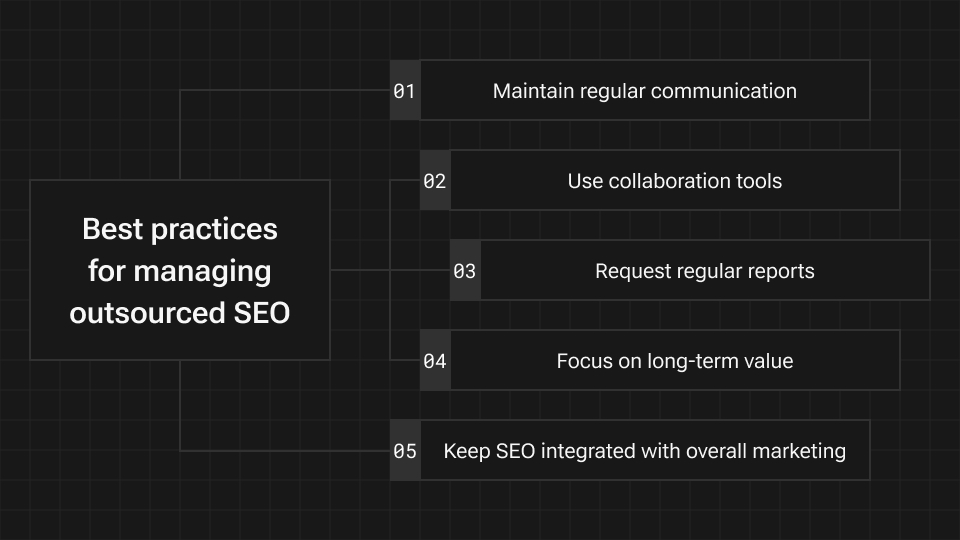
Successful SEO outsourcing doesn’t end at hiring the experts. The process needs to be actively engaged to get effective results. Here are the best practices that’ll help you maximise outsourced SEO efforts:
Maintain regular communication
Frequent communication ensures your company stays aligned with the external SEO team. Those weekly status updates and monthly reviews may seem trivial, but they keep the gears grinding. Otherwise, either side can easily lose track of what the other wants.
Use collaboration tools (Slack, Trello, Asana)
We mentioned communication just above, but it isn’t only about emails. Collaboration platforms like Slack and Asana make it easy for teams to stay on the same page. They let you create projects, divide them into tasks, and assign tasks to different individuals. You can create group chats and invite external collaborators to discuss SEO strategies seamlessly. In-house employees and external SEO professionals can maintain conversation threads to keep things running smoothly.
Request regular reports
Request frequent in-depth reports outlining what the SEO professionals have done and the results weighed against the agreed KPIs. Reports should also note which challenges were faced so that teams can brainstorm solutions. A monthly in-depth report is the most common standard adopted by companies working with SEO experts.
Focus on long-term value
SEO is a long-term process, so don’t chase after quick results. SEO efforts can take 4 to 9 months to get the desired impact, so avoid hopping between different SEO agencies if you don’t see results in a short period of time. It’s best to work with a skilled agency in the long term, not start from scratch repeatedly.
Keep SEO integrated with overall marketing
SEO isn’t a freestanding effort. Instead, it complements social media and email marketing campaigns, e.g., social media posts can use snippets from keyword-optimised, content-rich blog posts.
Hired SEO experts should collaborate with the teams running email and social media campaigns, with smooth communication channels. If silos exist between them, marketing campaigns won’t be as effective.
Common mistakes to avoid when outsourcing SEO
Many companies make mistakes when outsourcing SEO, leading to subpar results. In your case, understanding these mistakes and avoiding them helps you get the best results:
- Expecting instant results. Like we’ve said, SEO efforts can take 4 to 9 months to produce results, so some patience helps.
- Selecting on price alone. It makes sense that companies seek affordable prices, but price isn’t the only consideration. Some SEO services seem very cheap, but achieve that by using dodgy tactics, so they should be avoided.
- Skipping references. Sales pitches are nice, but look beyond them. Read case studies and testimonials, and ask your circles about SEO firms before working with them. The best SEO professionals have positive references from previous clients.
- Neglecting communication. Some companies treat SEO outsourcing as “set and forget,” but that’s the wrong approach. To get maximal results, actively engage with the external SEO team, with clear communication channels for them to raise issues.
How to measure SEO outsourcing success
We’ve emphasised steps to ensure SEO outsourcing success, but how is this success measured? What key metrics indicate if SEO outsourcing is going great? These metrics are categorised as leading indicators (rankings and traffic) and lagging indicators (revenue and leads).
Organic traffic growth
Increased organic traffic is the direct result of an effective SEO strategy. It’s what happens first, with other effects based on this improved traffic. Monitor the number of organic website visits originating from Google search results. Google provides free Analytics and Search Console tools to make this easy. Segment the results by landing page, origin keywords, and location to identify which SEO strategies are delivering more results, then double down on these strategies.
Always measure traffic in the long term, as a website may retain high ranking positions initially but gradually lose that traffic to Google AI overviews. Even when you observe higher traffic after SEO efforts, keep monitoring the stats and optimize further when you notice a traffic drop.
Keyword rankings
With proper SEO, your website’s rankings for major keywords should improve. For instance, an online bracelet store should track its positions for “handmade bracelets,” “premium bracelets,” and “premium bracelet for women attending weddings.” Track positions for both short-tail and long-tail keywords.
Conversion rate and revenue
Increased organic traffic is good, but better if it converts into sales. There’s little use getting many visits from search engines, but with visitors rarely buying items or booking consultations. Increased sales and conversions are the primary goals of outsourcing SEO, so these metrics should be closely monitored. Compare current sales against the past and note your conversion rates (the percentage of visitors who take a suggested action on your website). You should see an increase over time.
Lead generation
If you run a business-to-business (B2B) vendor or a service provider, generating leads from organic traffic visits is very important. You can rely on these leads to get future business, so closely monitor them. Note how many customers fill out your contact form, book appointments, and send messages. These leads may not translate into immediate sales, but they can in the long-term.
ROI of SEO outsourcing
All companies that pay for outsourced SEO want a good return on investment (ROI). How is this ROI calculated? It’s simple: (Revenue from organic traffic – SEO costs) / SEO costs × 100.
For example, if you spend $5,000 on outsourced SEO and earn $15,000 in sales from increased traffic, the ROI becomes ($15,000 – $5,000) / $5,000, × 100, making $10,000 / $5,000 (= 2) × 100 = 200%.
Because SEO can take a while to show results, it’s advisable to track your ROI over a 12-month period.
Conclusion
Outsourcing SEO the right way helps you achieve the best results, and we’ve described the right approaches to follow. What matters most is selecting a suitable SEO partner with a good track record and expertise in your niche. Want an accomplished SEO agency? Look no further than Why SEO Serious, with our years of experience running SEO for iGaming, blockchain, e-commerce, and financial services companies, plus other niches. Contact us today to see how we can elevate your search rankings.
Book a consultation with Why SEO Serious
FAQs
Is it safe to outsource SEO for a website?
Yes, outsourcing SEO is safe and produces good results if given to the right agency with a good track record. Outsourced SEO enables companies to focus more on core operations, while an external team focuses on boosting organic search traffic.
Which industries get the best results from SEO outsourcing?
Industries with high customer lifetime values benefit more from outsourced SEO. Examples are e-commerce firms, professional service firms, and real estate vendors. In these sectors, the value from organic traffic is noticeably high, so investing in outsourced SEO is worth it. Yet, companies in all other niches can also benefit from SEO outsourcing.
Can I outsource only one part of SEO?
Yes, you can outsource specific parts of SEO to external consultants and professionals, while retaining others in-house. For example, companies often outsource link building while in-house teams handle other SEO aspects.