Contents
Domain Authority Checker: How to Measure & Improve Your DA Score
Domain Authority (DA) is one of those metrics you can’t ignore as a website owner. Developed by Moz, a popular SEO platform, and since adopted by many other platforms, this metric indicates how likely your website is to rank high on search engines.
Understanding DA helps you determine how to optimize content for better search engine rankings. But how can you measure it? After measuring, what can you do to get a better DA score? Look no further than this guide, as we cover the ins and outs of this metric.
What is Domain Authority?
Domain Authority is a score, on a scale of 1 to 100, that predicts your website’s ability to rank high in search results. Notably, the DA is not an official metric from Google, Bing, or other search engines, but a third-party metric that relies significantly on a website’s backlink profile. Google’s algorithms don’t consider the DA score when ranking sites, so it’s more of a comparative metric than an absolute one.
To demonstrate, let’s use Moz’s DA checker to evaluate Google.com, literally the most visited site in the world:
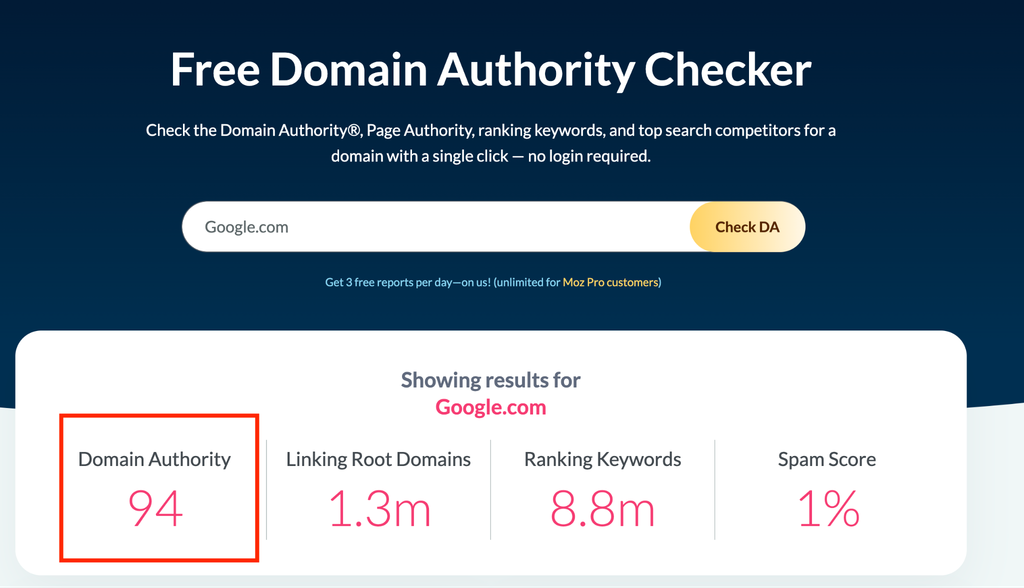
According to Moz, Google.com has a domain authority score of 94, very solid, and what you’ll expect from the most popular website. The closer to 100, the better.
Why does Domain Authority matter for SEO?
DA rankings are comparative metrics. They tell how well websites rank against rivals as they compete head-to-head to land on the top search results. Google doesn’t use DA as a direct ranking factor, but it helps website owners benchmark their performance against competitors.
A high DA correlates with high search visibility. Yet, your focus should be on relative growth, not absolute numbers. Your website may currently have a low DA score, but what matters is whether it’s on par with your top competitors. Focus on growing scores relative to your main rivals, not just getting near 100, which can be very difficult.
How to check your Domain Authority (top tools)?
Earlier, we illustrated how to use Moz’s DA checker to find your score, but that’s just one of many platforms. You can also use Semrush, Ahrefs, and SE ranking.
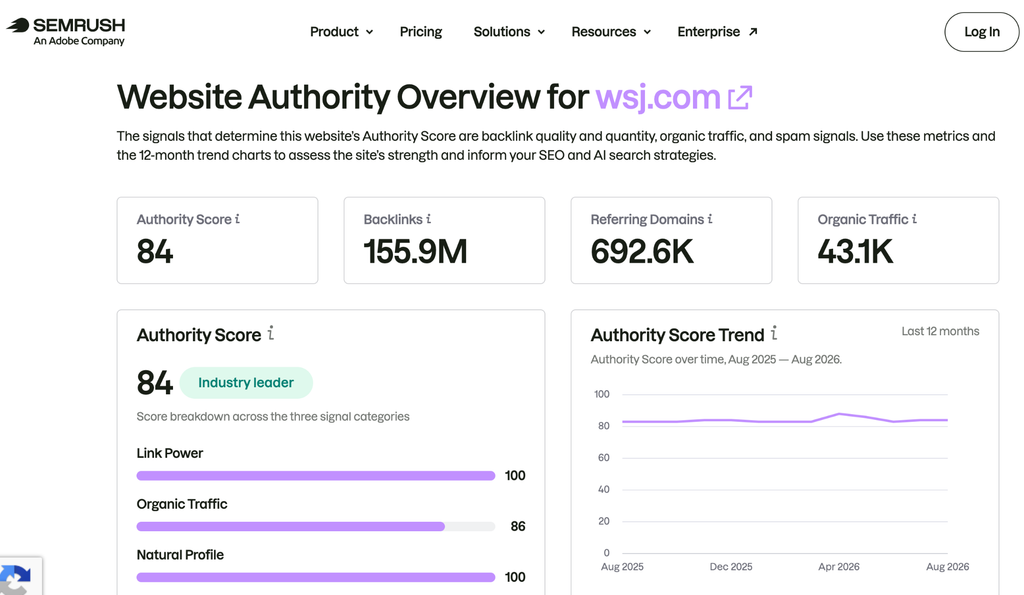
For Semrush, simply visit the Semrush Website Authority Checker and enter your domain. The domain SEO score will be presented in this format:
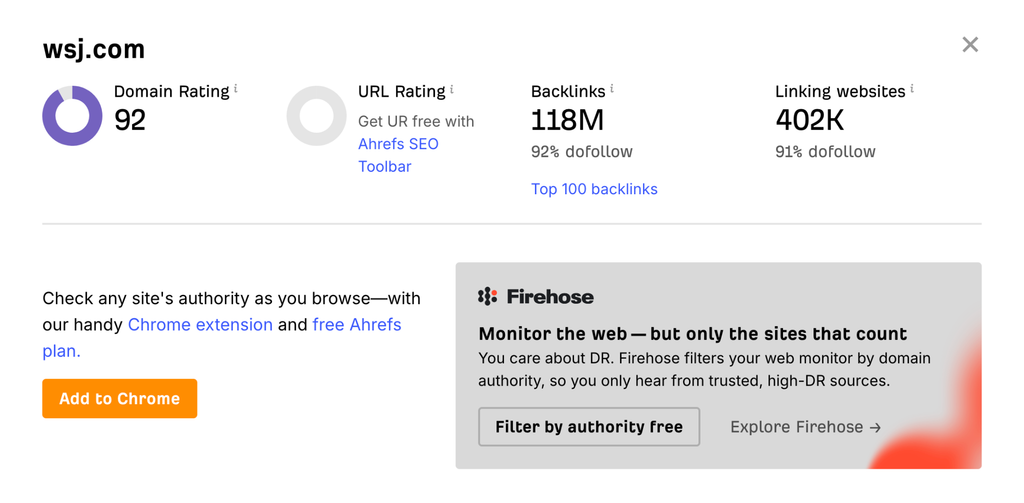
Ahrefs follows the same process as Semrush. Visit the Ahrefs Website Authority Checker and enter the domain name. You’ll get something like this:
For SE Ranking, visit the SE Ranking Website Authority Checker, enter the domain name, and view the results. It looks like this:
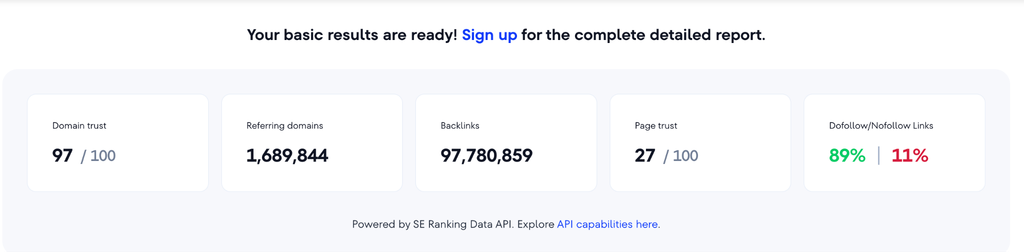
Notice how we just checked the DA score of the same domain, WSJ.com, and got different scores on Semrush (84), Ahrefs (92), and SE Ranking (97). That’s why we’ve emphasized that Domain Authority is not an absolute ranking but a relative one. Different platforms have varying methods, but it mostly centers on the number of backlinks and referring domains.
What is a good Domain Authority score?
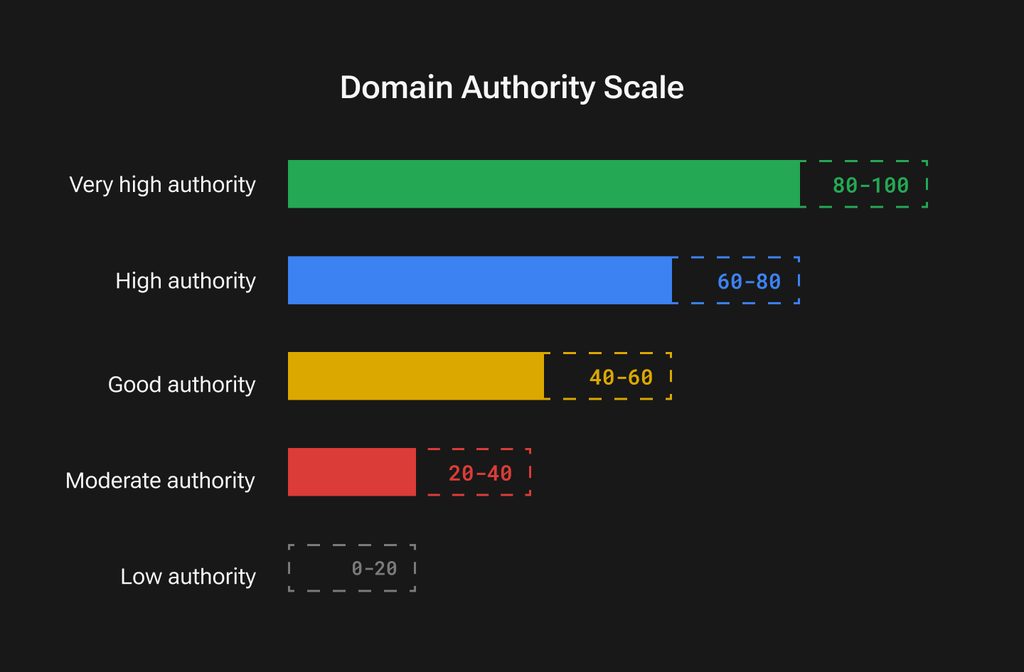
A good website authority score is relative to its niche and top competitors. The general trend is that 20 to 40 indicates a website gaining traction, 40 to 60 signals a website with established strength, 60 to 80 identifies popular websites, and 80 to 100 is the domain (no pun intended) of the most popular websites like Wikipedia, but it may vary based on your niche.
How is Domain Authority calculated (key factors)?
Semrush, Ahrefs, Moz, SE Ranking, and other platforms use a machine learning (ML) model to calculate Domain Authority. The model mostly considers the number of backlinks and referring domains to assign a score, plus a few other factors that vary by platform. That’s why the scores aren’t the same on every platform, as we demonstrated when searching the DA score for WSJ.com.
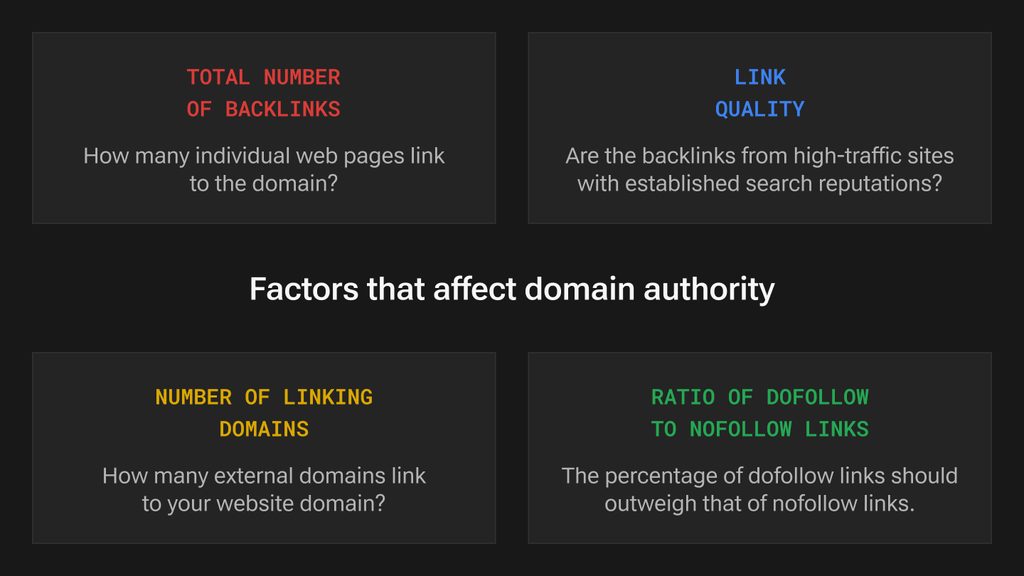
The core ranking factors are:
- Total backlinks. How many webpages link to the domain?
- Linking domains. How many other domain names link to the domain?
- Link quality. Backlinks from high-ranking, reputable sites contribute to higher scores.
- Dofollow/Nofollow links. When ranking backlinks, some platforms consider the percentage of dofollow and nofollow links. Dofollow instructs search engines to pass on authority, unlike nofollow links that pass no authority, so sites that lean towards dofollow get better rankings.

Domain Authority vs. Page Authority vs. Domain Rating: What’s the difference?
- Domain Authority (DA) predicts how likely a whole domain will rank on search engines.
- Page Authority (PA) tells how likely a single web page is to rank on search engines.
- Domain Rating (DR) measures the overall backlink strength of a whole domain.
Just like DA, Page Authority (PA), and Domain Rating (DR) are comparative metrics assigned by third-party platforms, not official Google metrics. Google’s algorithms don’t consider these three scores when ranking websites.
Domain Authority (DA) was created by Moz, Page Authority (PA) was also created by Moz, and Domain Rating (DR) was devised by Ahrefs, but they have all been adopted by many other SEO platforms.
Domain Authority (DA)
As we’ve explained, Domain Authority (DA) predicts how likely your website is to outrank competitors on search engine results. It compares your website’s SEO strength to that of rivals and the general niche.
SEO platforms like Moz, Semrush, and Ahrefs offer free DA checkers. You can quickly check your score with any platform, but scores may vary because platforms use slightly different ML models to analyze it.
Page Authority (PA)
Page Authority (PA) is similar to Domain Authority (DA), but for a single web page, not the whole domain. It predicts how likely a specific web page is to rank high on search engines. This score is mostly determined by the number of backlinks to that page and the quality of sites linking to it.
Just like Domain Authority, Page Authority follows a logarithmic scale of 1 to 100, with 20 to 40 signaling a page gaining traction, 40 to 60 indicating an established page, 60 to 80 identifying a popular page, and 80 to 100 signaling a very popular page having abundant backlinks. On this logarithmic scale, moving from 20 to 40 is much harder than moving from, let’s say, 60 to 80.
Semrush, Ahrefs, and Moz offer free Page Authority checkers. Select any platform and enter the web page address, and you’ll quickly see the assigned score.
Domain Rating (DR)
Domain Rating (DR) measures your website’s overall backlink strength. It focuses on the number of other domains linking to your website and the quality of these domains. Backlinks from high-ranking domains lead to a higher overall DR score.
This score measures how strong a website is compared to its peers. It focuses mainly on backlinks and doesn’t consider other factors like text quality, user experience, or organic traffic, so it’s not the final say. A low DR score means a need to work on amassing more backlinks, not that your website isn’t good enough to rank high on search engines.
Generally, the more quality backlinks a site has, the higher it’ll rank on search engines, so the Domain Rating is worth paying attention to.
How to improve your Domain Authority: Strategies
You’ve learned what Domain Authority is and how it compares to Page Authority and Domain Rating (DR). You’ve checked your score and are probably not satisfied with it. Then, how can you improve domain authority? There are several strategies, which we’ll cover below.
Create high-quality, link-worthy content
Domain Authority (DA) leans significantly on the number of referring domains and backlinks to your site. How then can you get backlinks from other domains? The first step is to create content that people naturally want to link to.
Your content should be informative, accurate, and relevant. It should answer the user’s query in detail, with infographics, charts, statistics, and other visuals to illustrate the topic. People really don’t want to read endless blocks of text without picturing a visual cue of what’s being described.
For example, in this article about Domain Authority, we’ve thoroughly discussed what it is, which factors contribute to the score, and how to check it, with several illustrations. Maybe we deserve a little pat on the back, but we’ll prefer backlinks as a reward 🙂
When people read in-depth content with original insights and precise illustrations, they’ll be more willing to link to it. So, focus first on creating good content, and the other aspects of getting a good DA score become easier.
Build a strong backlink profile (Earn .edu/.gov links)
All backlinks from trustworthy sites matter, but some matter more than others. A strong backlink profile leans towards referrals from high-traffic sites with established reputations, not just any site.
Particularly, backlinks from .edu websites affiliated with academic institutions and .gov links associated with government institutions carry significant weight. The same goes for high-traffic blogs, news sites, and portals. For example, a citation from a popular news outlet can do a lot for your Domain Authority.
How do you get backlinks from trusted sites? Creating good content is the “pull” factor but there’s also a “push” factor where you actively seek out backlinks. Here are examples:
| Fix broken links | Check a site you want to get backlinks from. Look for broken links on the site that lead to 404 pages or redirects, then alert the owner. Suggest your relevant content as the replacement, and you’ll likely earn a backlink for the favour of fixing the site owner’s broken link. |
| Guest posting | Contact other websites asking to publish guest posts. You can include one or two links to your site in each guest post, earning backlinks. |
| Backlink exchange | You can exchange backlinks with similar sites. They’ll link to yours, and you’ll link to theirs, a win-win. Feel free to contact site owners to offer a backlink exchange. |
Master on-page SEO and technical foundations
Get well-versed in SEO techniques, as this helps people find your content organically. It’s after finding this content that they’ll become willing to link to it, so pay attention to SEO strategies that’ll help your site rank higher on search engines. These include:
- Keyword relevance. Use relevant keywords that people often search for. These keywords should be inserted naturally into paragraphs, not feel forced. For example, “Learning how to increase domain authority involves these techniques…” sounds more natural than “These techniques are what you’ll learn when discussing how to increase domain authority.”
- Site speed. Optimize your website to load fast, as Google prioritizes faster sites. Compress pictures and images to their smallest possible sizes (without affecting quality), minimize the use of external scripts, and use a content delivery network (CDN) to load your content from servers closest to a user’s location.
- Tags. Every page should have a clearly stated H1, title, and meta description tag. These tags tell Google exactly what your content is about so that it’ll be shown to the right audience.
- Internal links. Add links to related pages to encourage readers to stay longer on your site and navigate it easily. For example, in this article, let’s sneak in a link to our guide on creating SEO content that ranks.
Remove toxic backlinks regularly
Backlinks from toxic sites are like poison. They eventually reduce your Domain Authority, not increase it, so they should be treated like weeds in a farm: immediate disposal is the solution. But the links aren’t on your website, so how can you get them removed? You can either request a manual removal, but this wouldn’t work many times, as the website owner can simply ignore your request. The best thing to do is disavow the links via the Disavow tool on Google Search Console.
- Google Search Console is a free tool for tracking your website’s performance and fixing technical issues affecting its search rankings. Anyone can use this tool after verifying ownership of their web domain.
To disavow links,
- Create a plain .txt file.
- In the .txt file, type domain:example.com on each line for every site you want to disavow. Precisely, replace example.com with the domain name you want to ignore.
- Upload the text file to Google Search Console’s Disavow tool.
How do you find the toxic backlinks to disavow? SEO platforms like Semrush and Ahrefs can do it for you. These platforms scan the web for suspicious links to your site, which you can quickly disavow.
Focus on topic clusters and internal linking
Just earlier, we mentioned internal links and sneaked in one to illustrate. Internal links direct readers to more information on your website. They also make it easier to navigate between different website sections.
You can use topic clusters, with a main page covering a broad, comprehensive topic and cluster pages targeting different subtopics. For example, the main page can be “SEO strategies, tips, and techniques” and the subtopics can include articles on “Domain Authority,” “Long-tail keywords,” “Local SEO,” and “B2B SEO.” The main page will link to the subtopic cluster pages, and the cluster pages will also link between themselves.
With internal linking, the web pages with many backlinks share their authority with weaker pages with few backlinks, boosting the site’s overall Domain Authority.
Entity-first SEO
With the rise of AI search results, where queries are answered directly instead of just directing users to links, Google now relies less on links and more on ‘entities,’ so entity optimization helps boost domain authority. Without entity optimization, Domain Authority grows for the sake of the number, not the increased traffic you’re after.
An ‘entity’ in this case is a unique topic, thing, or concept that search engines recognize your website as an authority on.
Topic clusters, which we discussed just above, are part of entity optimization. It also includes getting citations from other websites, maintaining consistent contact details for your website across the web, and adding schema markup to highlight key data. These factors make search engines recognize your website as an entity for specific topics, making it more likely to appear in AI search results.
Common limitations of Domain Authority (What it can’t do)
Domain Authority (DA) can do a lot, but it also can’t do a lot. It mostly considers the backlinks but hardly focuses on content quality. This means that a low Domain Authority score isn’t an overall assessment of your website. Rather, it assesses something specific that can be improved by amassing more backlinks.
More so, DA isn’t an official metric used by Google or other search engines. It’s one of various third-party rankings that are often called “vanity metrics.” They look impressive on reports, but do not have a direct impact on search rankings. You can still use these metrics to evaluate your site against competitors, but the main focus should be on core metrics like the number of organic visitors and conversion rates.
Conclusion
Domain Authority (DA) is one of many metrics, although not official, that measures your website’s competitive position. It’s a score that should be weighed against competitors, not just on the absolute scale of 1 to 100 (getting to 80-100 takes a long time and requires a lot of traffic).
You’ve learned what DA is, how it works, and how to improve it. Yet, you don’t have to do it alone. Feel free to work with a professional agency to improve your Domain Authority and other aspects of your SEO game. At Why SEO Serious, we do just that for you. Contact us today to see how we can elevate your website’s rankings to the top.
FAQs
What is Domain Authority?
Domain Authority is a score, on a scale of 1 to 100, predicting how likely your website is to outrank rivals in search results. It’s a third-party comparative metric, not an official Google metric.
How do I find out Domain Authority?
You can check your site’s Domain Authority through SEO platforms like Semrush, Ahrefs, and Moz. Simply visit the DA checker and enter the URL, and you’ll quickly see the assigned score.
Is Domain Authority still relevant?
Yes, Domain Authority remains relevant, but more as a metric to evaluate your site’s standing against competitors, not an absolute metric used by search engines.
What is an example of a Domain Authority?
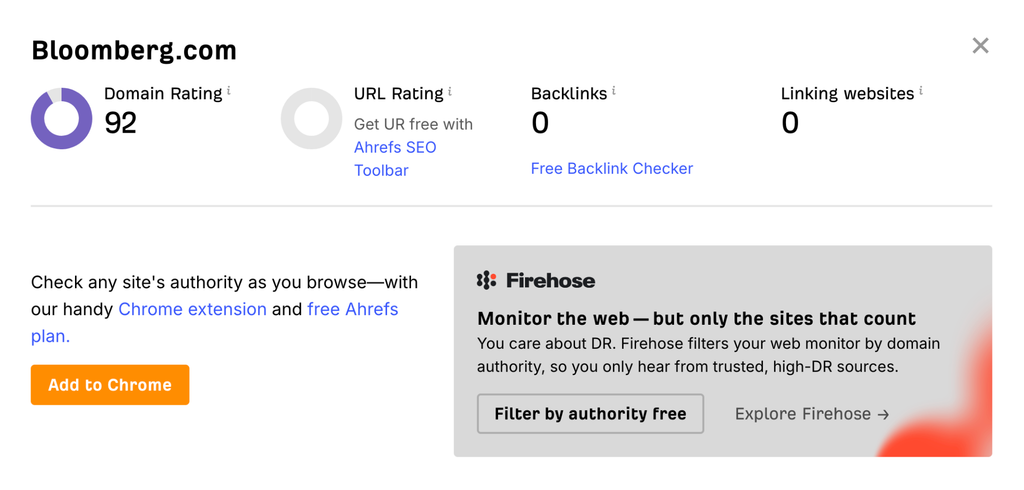
On a scale of 1 to 100, 20 to 40 signals a website gaining traction, 40 to 60 identifies a website with relatively good authority, 60 to 80 identifies popular websites with high authority, and 80 to 100 indicates a very popular website dominating its niche. For example, a search of Bloomberg.com, a very popular business site, shows a Domain Authority of 97, almost close to perfect: