
Contents
SEO for Hotels
You run a hotel, and that’s great! But you’re competing with numerous other hotels in your city, and customers need a reason to choose yours over the alternatives. More so, customers have to discover your hotel in the first place, and Google is the go-to option for finding hotels. How can your hotel rank high on Google and attract customers, and what can you do to outrank rivals in listings? Here’s your guide to boosting hotel search rankings and attracting guests.
What is SEO for hotels?
Search engine optimisation (SEO) entails tweaking your website to earn higher search rankings. For a hotel, it focuses on building a highly optimised website and a Google Business Profile to rank high on search engines. When someone searches for “Hotels in [your city],” you want to be the brand that’ll pop up. Hotel SEO covers the strategies that’ll help you do that.
Understanding Hotel SEO basics
Hotel SEO revolves around key strategies, including keyword optimisation, technical site health, on-page optimisation, and local SEO.
- Keyword optimisation. Your website should incorporate relevant keywords like “hotel in [city]” or “getaway space near [landmark location].” Target users searching for specific amenities like “pet-friendly hotel,” “budget-friendly hotel,” “premium staycation destination,” etc. Creating content that matches search intent draws traffic to your hotel website.
- On-page optimisation. Hotel room pages should have precise title tags and meta descriptions describing what’s offered. Each page should have one H1 tag, then structured H2 and H3 tags to describe amenities. Rooms should be showcased with high-quality visuals, with each image having an alternative text (alt text) description.
- Technical site health. The whole website should be optimised for smaller mobile screens. All text and visuals should load smoothly on mobile devices, just as they would on a desktop. The website should also be optimised for fast loading speeds, as Google prioritises faster sites.
- Local SEO. Your hotel needs a complete Google Business Profile, which displays key details like room rates, phone number, email address, physical location, and customer reviews.
Why hotel SEO differs from regular SEO
Hotel SEO is more specific than regular SEO. While regular SEO focuses on broad keywords and a massive audience, hotel SEO focuses on location-specific keywords and audiences. You’re mostly after people searching for “hotels near me,” “hotels in [your city],” and similar queries. The goal is to convert high-intent searches into room reservations.
Why is hotel SEO important?
For safari lodges, resorts, boutique hotels, and other hotel types, SEO has a direct link to occupancy rates and revenue. An effective SEO strategy means more people find your hotel online and book stays. With the right service, a first-time customer can convert into a repeat client.
Increase online visibility
Firstly, SEO improves your hotel’s online visibility. People are more likely to find you when searching for places to stay, particularly in Local Packs and map results. For example, a random search for “Good hotels in Hong Kong” shows the following results:
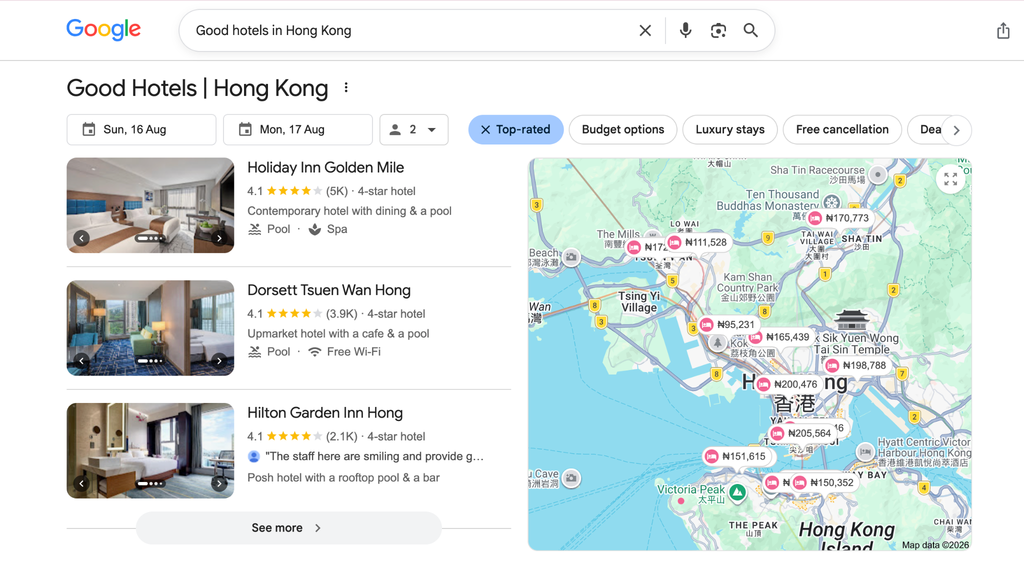
The three hotels are displayed in the Local Pack, the most prominent section of location-based search results on Google. Businesses that appear in the Local Pack get considerable foot traffic.
Attract the right guests
Proper SEO helps your hotel attract the right guests who need exactly what you offer. For example, budget hotels want customers seeking affordable options, and luxury hotels want customers seeking pricey accommodations with more amenities. Proper SEO ensures each type of hotel gets its ideal customer.
Drives more direct bookings
The right SEO strategy improves the odds of getting direct bookings on your website, instead of through third-party platforms that charge a 10% to 25% fee. More direct bookings translate into more revenue, instead of handing significant sums to third parties.
Stay ahead of competitors
Few sectors are as competitive as the hotel industry, with many venues offering diverse amenities and vying for a similar customer base. Effective SEO helps you stand out in search results pages and win customers. It’s one area to invest in to beat competitors, particularly premium brands that you can hardly compete with on amenities.
Hotel SEO keyword research
In hospitality SEO, keyword research centers on location and intent. You’re targeting high-intent keywords from customers seeking something specific, like “Hotels in Barcelona” and “Affordable lodging in Dubai.” It isn’t about generic hotel-related keywords, but about precise queries.
Types of search intent
What types of search intent do hotel managers target? Let’s examine them below:
Informational
Informational intent is about users seeking ideas and researching options. For example, someone searching for “Things to do in Los Angeles” is seeking information about a potential visit, during which they’ll likely stay at a hotel.
Commercial
At the commercial stage, the user has decided where they’re visiting and are comparing options. Queries like “Best premium hotels in Manila” take precedence.
To rank for commercial-intent searches, you can create comparison guides (but without bad-mouthing rivals), highlight guest reviews, and include detailed information about your hotel.
Transactional
In the transactional stage, the user is ready to book a hotel reservation and looking for something precise, like “Hotel rooms with pool views.”
Transactional searches have clear intent, and you can rank for them by having clear pricing pages, clear call-to-action buttons (e.g., “Book Now” and “Reserve a Room”), and a smooth mobile-optimised reservation process.
Navigational
Navigational intent covers users searching for a specific brand, like “Hilton Hotel Tokyo.” For these searches, you want your hotel’s website to rank first and attract direct bookings, not online travel agencies like Booking.com and Agoda to rank first.
Broad vs. Long-tail keywords
Hotels can either target broad or long-tail keywords. Broad keywords are short and have high volumes, like “Hotels in Jakarta” and “Singapore resort.” On the other hand, long-tail keywords comprise 3+ words, like “Best resorts near Bali” and “Singapore budget hotel deals.” Long-tail keywords have lower search volumes than broad keywords, but the intent is higher.
Finding your hotel keywords
How do you find the right keywords to target? After all, hotel seekers search for an endless combination of words and phrases, so which exactly should you focus on? The answer lies in data. Your target keywords should be data-driven, sourced from SEO research platforms like Semrush and Google Search Console.
With Semrush, you can identify the relevant hotel-related keywords to incorporate into your website content. Google Search Console shows the exact keywords and phrases drawing people to your website, and you can focus on them to gain traffic. Semrush also lets you analyse rival hotel websites’ keyword strategies, but Google Search Console doesn’t have this feature.
Whether searching based on amenities, location, or events, SEO platforms like Semrush help you identify the best keywords to target.
Note that hotel-related keywords have seasonality-related trends. For example, during summer months and college spring break periods, people search more for “beach resorts in [city],” and during cold winter months, people increasingly search for “ski resorts in [city].” Christmas and New Year’s Eve also bring massive demand spikes for hotel-related searches as people travel to enjoy the break. Platforms like Semrush help you target seasonal keywords at the right time.
On-page SEO for hotels
On-page SEO is highly important for hotels. Every room and service page should be optimised with the right headers, tags, images, structured data (schema markup), and content. Let’s see how to do that below:
Page titles, meta descriptions, & URLs
Every page should have a clear title tag highlighting what it’s about. It can be in this format: “Keyword + hotel name + city,” e.g., “Suites at Frasers Hotel Singapore.”
Each page also needs a compelling meta description tag that highlights its unique selling point, such as “Need an extended stay? Frasers’ family-friendly rooms are the first choice for leisure travelers seeking a memorable experience.”
Page URLs can also be optimised to be brief and precise. It should be more like “Example.com/two-bedroom-suite,” not “Example.com/suite12345.”
Header tags optimisation
Pages should have proper headers, with one H1 tag defining the main title and H2, H3, H4, etc., tags for subtopics. For example, the H1 tag can be “Two Bedroom Suite,” an H2 tag will highlight “Amenities,” and the amenities will be grouped under H3 tags like “Furnishings,” “Kitchen features,” and “Entertainment.”
Image optimisation
Firstly, use high-quality images and videos of your hotel rooms, gallery, restaurant, and other amenities. High-quality footage gives customers a good impression even before walking into your hotel.
Then, images should have descriptive filenames like “[Hotel Name] Two Bedroom Suite.jpg” for your two-bedroom suite. Every image should have alt text that tells search crawlers what it’s about, like “Two Bedroom Suite at [Hotel Name].”
Compress images to their smallest possible sizes without sacrificing quality. Smaller images help websites load faster, a major factor considered by Google.
Internal linking strategy
Add internal links to different pages of your website. For example, a room page can link to other pages for the restaurant, spa, and swimming pool area. You can also link to blog posts highlighting activities for hotel visitors to participate in. Internal links guide visitors to related pages and help search bots crawl your website easily. You’d be surprised how many activities a hotel occupant will participate in after finding them through internal links.
Structured data (Schema Markup) for hotels
Schema markup, also called structured data, refers to specialised code snippets that highlight key information to search engine crawlers. It uses code vocabulary from Schema.org to label entities like check-in and check-out times, accepted currencies for payments, location, and price range. Here are some examples:
| aggregateRating | The overall rating of your hotel from customer reviews. |
| amenityFeature | A specific amenity of your hotel. |
| event | Upcoming or past events associated with your hotel. |
| telephone | Your hotel’s phone number. |
You can find the complete list of codes for hotels on Schema.org. Insert relevant codes on your web pages to highlight specific information for search engines.

Local SEO for hotels
Local SEO is the most important aspect for hotels, a business that revolves around location. You’re competing head-on with hotels in your vicinity, so standing out in location-based search results is non-negotiable. Here’s how to stand out:
Google Business Profile optimisation
Create a Google Business Profile and fill it with key information like your price list, physical address, phone number, amenities, and restaurant menu. Your hotel profile can also highlight customer reviews and include high-quality photos & videos.
Take this hotel profile for example:
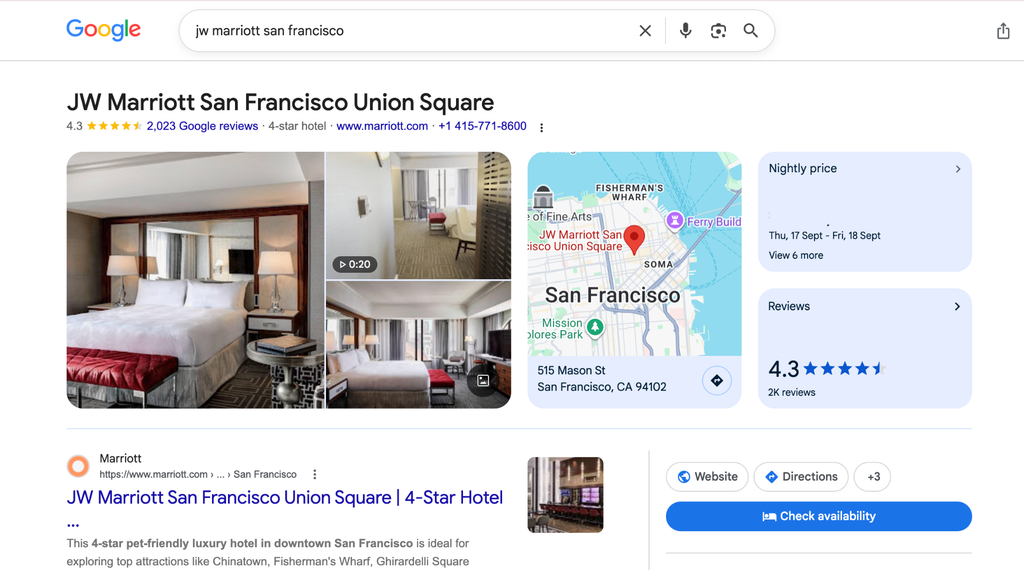
Observe how this Google Business Profile highlights the hotel’s reviews, address, website, phone number, photos & videos, location, and price range. That’s how yours should be.
Notably, you can add booking links to your Google Business Profile. Users who encounter your profile can quickly book hotel stays without you paying commissions, unlike when using online travel platforms.
Instead of providing just a list of links to click, Google now offers AI Overviews, which are direct answer summaries to users’ queries. For example, if someone searches for “Which hotels are the best in London?”, they’ll see an overview summarizing the best hotels, with citations from different sources.
Getting your hotel mentioned in AI citations is now as important as appearing in conventional search results. A complete Google Business Profile, proper schema markup, and positive third-party reviews help your brand get cited in AI Overviews, and these are all essential parts of local SEO.
Local citations and NAP consistency
Your hotel’s name, address, and phone number (NAP) should be the same on its Google Business Profile, website, and every directory where you’ve created a profile. Google uses consistency as a trust signal, so it affects how high your hotel ranks. Inconsistent details can significantly dent rankings, so ensure the details match across all directories.
Local keyword optimisation
Incorporate local keywords like “hotel near [landmark place],” “hotel in [neighborhood],” and “hotel in [city]” into your content. These keywords can be placed in H1 and H2 tags, title & meta description tags, image alt texts, and text bodies. Local keyword optimisation increases the chances of getting cited by Google.

Fill out our form to book a consultation
Managing online reviews (Google, TripAdvisor)
Intending hotel occupants look at reviews when deciding where to stay. Hotels with overwhelmingly positive reviews are more likely to attract occupants, so provide the best possible service to garner positive reviews.
All reviews won’t be positive, but what matters is how you manage them. Reply to customer reviews, with an appreciative tone for positive reviews and a reconciliatory tone for negative reviews.
“We’re glad you enjoyed your stay, and we hope to see you again” is a typical response to a positive review, and “We’re sorry for the inconvenience, be assured that we’ve rectified the issue and strive to always provide good service” is a fitting response for a negative review. Avoid replying in a negative tone, as it looks unprofessional to potential customers.
Local link building
Build backlinks from local directories, event sites, blogs, events, and tourism associations. For example, a citation from your city’s tourism board can draw a lot of traffic. You can partner with local event planners to jointly host events and get cited as a result. Google considers backlinks when citing websites, so the more relevant backlinks acquired, the better.

Off-page SEO for hotels
Now, let’s look at effective off-page SEO for hotel brands. This centers mostly on amassing backlinks and social media mentions.
Link building strategies
Above, we just mentioned the importance of backlinks from local directories and blogs. Yet, you can target much more than that. Backlinks from travel blogs, travel agencies, and news websites go a long way in attracting traffic. Creating in-depth content naturally encourages such websites to link to yours.
Social media signals
Social media doesn’t directly boost search rankings, but it increases brand awareness and positions your hotel as a destination to the right audience.
Just as people find hotels via search engines, they also seek them via social media, so having an active page on Instagram, X, and Facebook helps a lot. The page should display top-notch photos and videos of your hotel, announce events to customers, promote offers, and give important updates.
When someone has already seen your hotel on social media, they are more likely to click when Google suggests it as an option.
Building Domain Authority (DA)
Domain Authority (DA) is a score that predicts how well your website will rank on search engines. It’s not an official Google metric, but a metric invented by Moz and since adopted by other SEO platforms. It forecasts how well your site will rank relative to competitors, and amassing backlinks from high-quality sites helps boost this score.
For instance, links from travel publications and tourism agencies help boost your Domain Authority, so try to get backlinks from these sites. Avoid spammy sites that post little and irrelevant content, as these can reduce Domain Authority, not increase it.
Technical SEO for hotels
Hotel SEO services can’t be complete without technical SEO. The technical foundation is important for hotel websites powered by booking engines, so let’s see how to optimise in this aspect:
Website speed optimisation (Core Web Vitals)
Google uses three Core Web Vitals to evaluate a website’s user experience:
- Largest Contentful Paint (LCP), which measures loading speed, with a good score being a web page completely loading within 2.5 seconds.
- Interaction to Next Paint (INP), which indicates how quickly a page responds when a user clicks, taps, or scrolls. Under 200 milliseconds is the ideal score.
- Cumulative Layout Shift (CLS), which tracks how unexpectedly pieces of content move on a web page, like a picture moving up or down after an ad loads. The ideal score is under 0.1.
To optimize for speed, compress photos and videos to their smallest sizes, cache files to make them load quickly in a user’s browser, and use a content delivery network (CDN) to serve your website’s content from servers closer to each user’s location.
Mobile-friendliness (Responsive design)
Your hotel website should adjust perfectly to smaller mobile screens just as it would on a desktop. Mobile devices account for over half of online traffic, so this optimisation ensures you don’t miss out on most bookings. Google also prioritises mobile-friendly sites in search rankings, so pay close attention to this factor. Use legible fonts, click-to-call buttons, responsive images & videos, and implement a booking flow that works well on mobile devices.
XML sitemap and Robots.txt
Upload an XML sitemap and a robots.txt file to your website’s root directory. A sitemap.XML file lists all your website’s important URLs, helping search crawlers find and index the most relevant pages faster.
A robots.txt file tells search crawlers which pages to index and which not to index. It’s akin to an instruction manual accompanying a map, telling you where to go and where to avoid.
HTTPS and security
Your site should be protected with HTTPS, creating an encrypted connection between the server hosting your content and the user’s web browser. An encrypted connection prevents hackers from intercepting sensitive data in transit.
An HTTPS certificate is essential for Google indexing. Search engines avoid non-secure websites like the plague, so getting the certificate is one of the first things to do when creating your hotel website.
Fixing crawl errors and broken links
Scan your website for broken links that redirect to 404 pages or unintended web pages. These links hurt the user experience and confuse crawlers, reducing the chances of ranking high in search engines, so they should be removed or replaced immediately.

Hotel SEO content creation
Your hotel needs content to stand out from numerous competitors. The content should differentiate your hotel and answer the key questions asked by potential occupants. Let’s see how:
Room and service pages optimisation
Every room type should have a distinct page with clear descriptions and a unique selling point. List the room size, highlight the views, and state all amenities that occupants get to enjoy. People don’t just want a place to stay, but want a full-blown hotel experience, so highlight what you offer that others don’t.
Blog content strategy
Create a blog section where you’ll write about local events, travel tips, neighborhood guides, and tourist activities. People who’ll eventually stay at your hotel are likely coming for various events, so writing about these events attracts them to your site. When someone searches for activities for tourists to participate in, they can land on your hotel blog and, soon after, start booking a stay.
Creating unique, valuable content (E-E-A-T)
For your hotel blog, Google prioritises helpful content that fulfills the E-E-A-T model: it demonstrates Experience, Expertise, Authoritativeness, and Trustworthiness.
- Experience denotes having first-hand experience with the blog topic. For instance, writing like someone who actually participated in the tourist activities they recommend demonstrates experience.
- Expertise demonstrates skill or extensive knowledge of the topic. Original insights and quotes from reputable sources help demonstrate this expertise.
- Authoritativeness denotes being recognised as a reliable hotel industry source. Adding author bios of real staff members, explaining their local connection and background, helps demonstrate authoritativeness.
- Trustworthiness denotes the content being accurate and honest in line with industry consensus. Highlighting real customer reviews, clear booking and refund policies, and real images (not stock footage) demonstrates trustworthiness to readers.
Essential hotel SEO tools
Throughout this guide, we’ve mentioned some valuable tools that help optimise your hotel website for high search rankings. Let’s look at more of them:
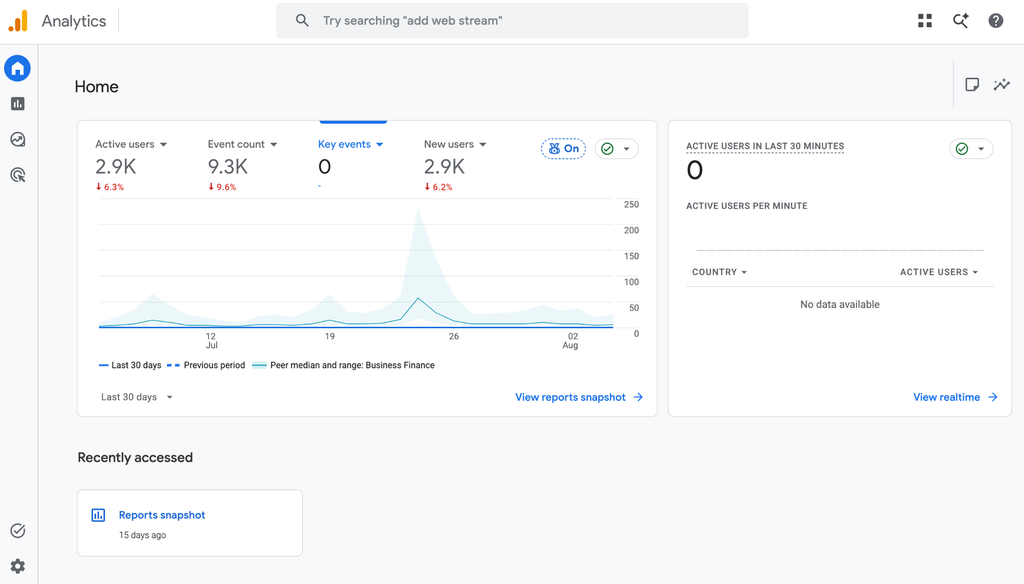
- Google Analytics 4. Google offers a free Analytics tool to track key website metrics like the number of visitors, total sessions, average duration spent on site, and conversion rates on hotel reservation pages.
Source: Google
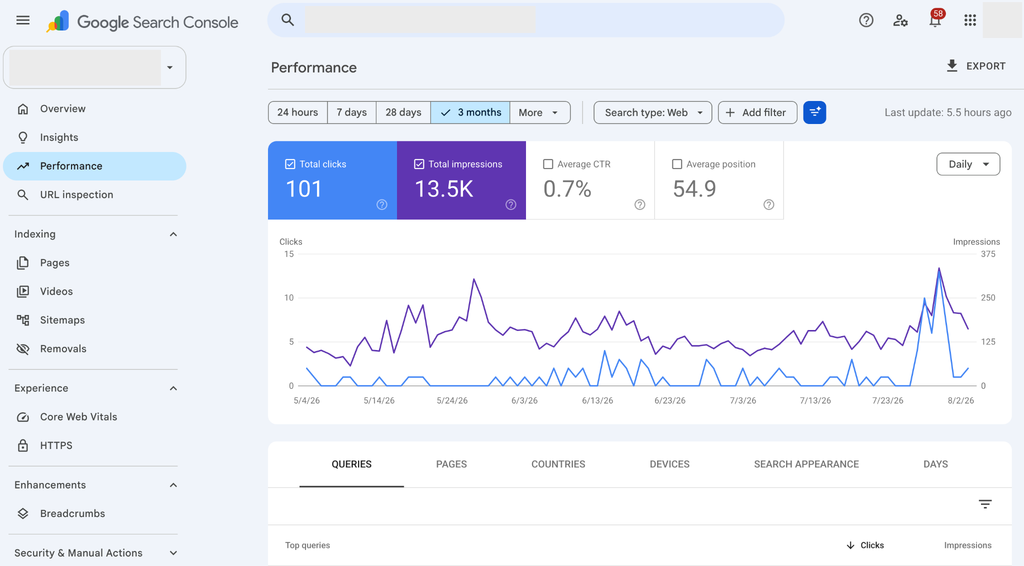
- Google Search Console. Another free tool that lets you easily see which keywords attract visitors to your website and your average website position, number of impressions, and click-through rates for relevant keywords.
Source: Google
- Google Business Profile. Google lets you fill out a Business Profile, complete with details like physical address, phone number, amenities, price lists, and photos, helping customers discover everything they need about your hotel in one swoop
- Google Keyword Planner. Google’s free Keyword Planner helps you discover the right keywords to target for increased traffic.
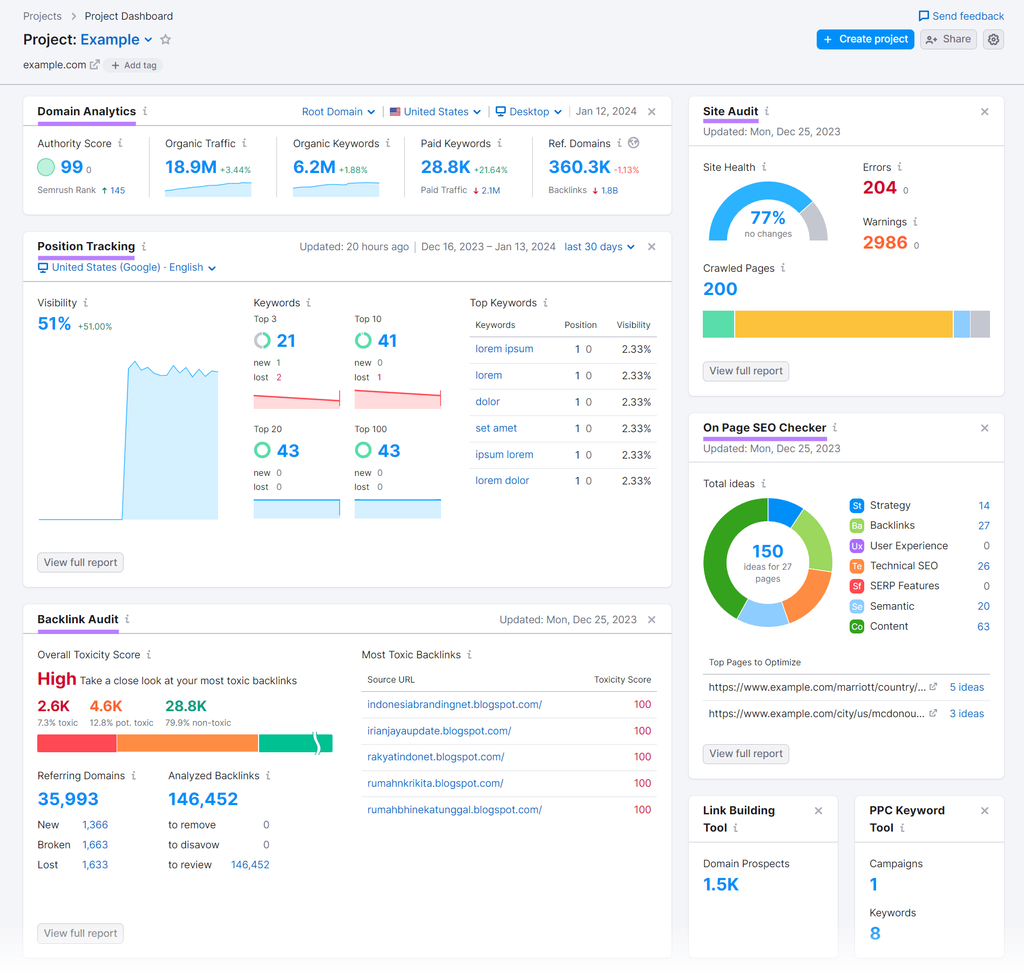
- Semrush/Ahrefs. Semrush and Ahrefs are two highly popular, versatile SEO platforms, helping with everything from keyword research to position tracking, extensive SEO audits, competitor analysis, backlink analysis, and traffic monitoring.
Source: Semrush
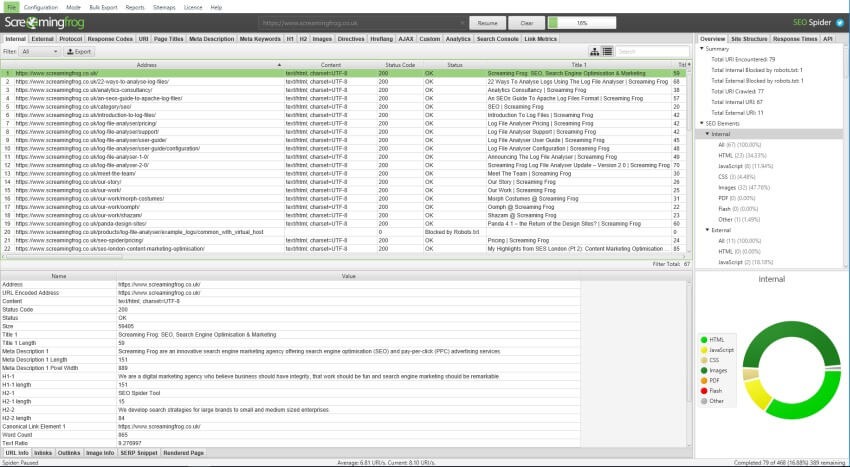
- Screaming Frog. An SEO auditing tool that deeply scans websites to identify SEO issues like broken links, redirect loops, missing meta tags, and duplicate URLs.
Source: Screaming Frog
How to measure hotel SEO success
You’ve learned a lot about implementing a proper hotel SEO strategy and the tools that help you do that. But then, how do you measure the success of your SEO strategy? How do you know if you’re on the right track? These are the core metrics to look out for:
Organic traffic growth
Gaining organic traffic is the main goal of SEO, so this is the first metric to consider. Compare your organic traffic week-to-week, month-to-month, and year-to-year. Note that SEO efforts can take 3 to 12 months to yield results, so don’t expect instant gains. Monitor your organic traffic over the long term: increasing impressions and clicks shows you’re on the right track.
Note that SEO metrics differ for hotels than other types of businesses. It’s not just about having the most visits, as some hotel-related queries are difficult to rank for, but more about getting conversions from those visits.
Keyword rankings
Track your hotel’s position for the top-20 relevant keywords like “hotel in [city],” “hotel in [neighborhood],” and “hotel near [landmark].” Particularly, check whether your hotel makes it into the coveted Local Pack for these keywords. Higher rankings show that you’re implementing the right SEO strategy.
Direct bookings and revenue
As effective SEO draws more people to your site, some visitors eventually book a stay at your hotel. So, monitor your number of direct bookings and sales originating from search traffic. Increased bookings signal an impactful SEO strategy.
Conversion rate
It’s one thing to get views on hotel room pages and another for viewers to book room stays. The conversion rate is the percentage of viewers who eventually proceed to book a room. 1.5% to 3.5% is the average conversion rate for hotel room pages, but 4% to 7% is the ideal range for top hotels. You should target 4% to 7% and make adjustments if yours fall significantly below this range.
Click-through rate from search results
Similarly, many people can view your hotel on search results, but what matters most is how many people eventually click on your link, known as the click-through rate (CTR). Closely monitor your CTR before and after implementing SEO strategies, and you should observe improvements.

Common hotel SEO mistakes to avoid
Here are common mistakes to avoid in your hotel SEO strategy:
Ignoring local SEO
Hotel SEO is mostly about local optimisation. Your main competitors are hotels in your city and neighborhood, not just anywhere, so most strategies revolve around local SEO, which some people unfortunately ignore.
Duplicate content (across room pages)
Hotel websites often have duplicate content across room pages, because rooms often share common features. However, duplicate content can dent search rankings. Treat every room page as a separate entity with a unique selling point. Write new content from scratch even when amenities overlap, as this boosts the chances of outranking competitors.
Slow website speed
Slow website speed discourages intending occupants from booking stays, and it also affects Google rankings. When a hotel website takes too long to load, the user often hits the X button and looks for an alternative. That’s why we’ve emphasised tweaking your website to ensure fast loading speeds.
Poor mobile experience
When building hotel websites, people often focus too much on the desktop experience and forget that a lot of traffic comes from smartphones. Avoid this mistake, as websites with a poor mobile experience get fewer conversions. Ensure all text and visual elements are optimised for smaller mobile screens.
Not managing reviews
It’s quite easy to ignore customer reviews, but it’s a major mistake. Brands that ignore reviews often look like they don’t care much about customers. Intending hotel occupants want to meet a brand that cares about customers enough to respond to reviews, both positive and negative. Ensure you do that to avoid losing business to competitors.
Hotel SEO agency vs. In-house
With all you’ve learned about hotel SEO, you may be wondering, “Do I do all these myself, or hire an agency to handle it?” There’s no exact answer, as it depends on your budget, team, and business size. Let’s see the pros and cons of each.
An agency gives you regular access to SEO experts and writers who’ll optimise your hotel website for higher search rankings. With an in-house SEO team, you have full-time access to experts dedicated to creating content solely for your hotel brand, but a skilled in-house SEO team can be costly and take time to build. In-house is best reserved for large hotel brands with big budgets, while smaller and mid-sized hotel brands will be served better by SEO agencies.
Hotel SEO strategy checklist
On-page SEO
- Add unique title and meta description tags to every page.
- Set up header tags, with H1 for the main title, and H2, H3s, H4s, etc., for amenities and services.
- Use high-quality images and add alt text to each image.
- Clearly state your hotel name, address, location, services, and amenities on the website.
- Add internal links on website pages.
- Create valuable content like travel guides and local event updates to attract organic traffic.
Local SEO
- Create and fill out your Google Business Profile with key details.
- Add high-quality photos to your Google Business Profile.
- Incorporate local keywords into your website.
- Seek backlinks from local directories and businesses.
- Actively respond to customer reviews on Google.
Technical SEO
- Make your website mobile-friendly.
- Optimise your site for fast loading times.
- Implement HTTPS security with an active SSL certificate.
- Add schema markup (structured data) to label key data for search engine crawlers.
- Add an updated sitemap.XML file and a robots.txt file.
Off-page SEO
- Seek backlinks from other sites.
- Create and maintain an active social media page.
Conclusion
For hoteliers, SEO is a long-term investment that bears good results if done correctly. Your SEO efforts can generate sizable organic traffic in the long term and lead to more bookings. In this guide, we’ve covered the ins and outs of implementing an SEO strategy for a hotel brand, so it shouldn’t be a problem. Yet, if you need help, you can always hire an SEO agency to craft and deploy your strategy. Why SEO Serious is available to be your SEO partner and take your brand to the top of search results pages, so contact us today to book a consultation.
FAQs
How do I implement SEO for hotels?
SEO for hotels centers on local SEO strategies, including having a complete Google Business Profile, responding to user reviews, and incorporating localised keywords into content. However, there are also technical SEO aspects like mobile optimisation, on-page aspects like creating valuable content, and off-page factors like amassing backlinks.
What is SEO in the hotel industry?
SEO for hotel industry players means optimising their websites to rank high in search results and gain organic traffic. The main goal is to increase online visibility and gain traffic that’ll eventually convert into real bookings.
What are some important elements of on-page SEO for hotels?
Important on-page elements include adding unique title and meta description tags to every page, stating clear information about your hotel services & amenities, adding descriptive alt text to all images, and using headings & subheadings to set up a clear content hierarchy.