Contents
AI-Powered Search Explained: SGE, AI Overviews & SEO in 2026
The Search Generative Experience (SGE) is an AI-powered Google feature that provides direct, conversational answers to queries instead of just links.
AI Overviews are the summarized, conversational answers displayed at the top of many search queries as part of the Search Generative Experience.
SGE has disrupted the SEO scene, with an increasing need for websites to be cited in Google AI Overviews, not just in link lists. On the bright side, this disruption has opened a new opportunity for smaller publishers to compete and outrank rivals.
What is SGE — and what happened to it?
In May 2023, Google launched an experimental feature that integrated AI-generated responses directly into search results. Instead of just displaying links or featured snippets, AI algorithms began providing conversational, direct answer summaries. This was called the Search Generative Experience (SGE).
A year after, SGE transitioned from an experimental feature to a full-fledged feature under the name “AI Overviews.” This feature is now an established part of the Google user experience.
SGE meaning in SEO: Why the term still matters
Although they aren’t the traditional list of blue links or featured snippets, AI Overviews still matter in SEO. With AI summaries, many users now see direct answers at the top of the page and don’t scroll down, so getting cited in these summaries has become essential. Creating content that responds to deep user intent and writing in a natural, conversational tone have become more crucial in SEO, because they boost the chances of getting cited in AI Overviews.
From SGE to AI Overviews to AI Mode: Timeline
SGE was released as an experimental feature in May 2023. A year later, in May 2024, it began a full SGE rollout and called the feature AI Overviews.
In May 2025, Google released AI mode, a dedicated tab that sits inside Google search. This tab, powered by Google’s Gemini assistant, breaks down complex, multi-part questions into smaller sub-queries, then provides detailed answers. For users, it feels like speaking directly to someone answering their questions. AI Mode and AI Overviews are the key components of the Search Generative Experience.
Why should you care about SGE?
Google used to show you where to find the answer. Now it’s trying to give you the answer itself. After ChatGPT changed how people search, Google responded with AI Overviews. They are AI-generated summaries that appear before the traditional list of links. Google calls this the Search Generative Experience (SGE).
For website owners, the SGE search experience means visibility is no longer just about rankings. It’s about becoming one of the sources Google’s AI decides to cite. How have AI overviews changed search engines, and what does it mean for your website? How can your website remain relevant in the age of overviews? Let’s find out in detail.
Why search is changing now: The forces behind AI-powered SERPs
AI-generated output isn’t just a new search engine feature. Instead, the Search Generative Experience is a whole paradigm shift. Users have come to expect AI overviews as a standard response to their queries, while they can also scroll through links below to get what they want. This shift is driven by the rise of AI-based large language models (LLMs) like ChatGPT, competitive pressure, and, of course, user behavior. Let’s explore how it came to be.
From keywords to intent: How user behavior evolved
The usual search engine experience revolved around users typing queries and getting a page of suggested links to click on for answers. However, since ChatGPT debuted in 2022 and launched an LLM boom, the pattern has changed. Users began expecting the same AI overviews found on ChatGPT on their search engines, and Google had to meet competitive pressure. Now, when users search for phrases, they get conversational AI answer summaries, then links afterward.
The role of LLMs and multimodal AI in modern search
The SGE research experience is powered on the backend by large language models (LLMs). These models are trained on vast amounts of data to infer, summarise, translate, and generate human-like output. They use a neural network design to process entire sentences, then run calculations to guess the most likely response to the sentence, based on their training. OpenAI’s ChatGPT is the most popular LLM, but Google also has its popular Gemini model.
Competitive pressure: Why Google had to act
After LLMs debuted and took the world by storm, Google had no choice but to act. The alternative was gradually losing users to search engines and denting its search engine dominance. Google released its native Gemini LLM in 2023, and this LLM powers the search generative experience users now see on its website.
Weirdly enough, Google has begun working on AI models long before ChatGPT debuted, or even before most people heard about LLMs. However, ChatGPT’s release in November 2022 is what kickstarted the LLM boom, and Google had to act fast. First-mover advantage doesn’t always apply, it seems.
AI overviews vs. Classic SERP: What actually changes on the page
Classic search engine results pages (SERPs) are a list of suggested links to click on. AI overviews are direct answer summaries that have been added, appearing at the very top of Google search results. These two, in a way, complement each other.
Where organic, paid, and local results move
AI-generated overviews occupy the top of search results pages, while organic, paid, and local search results sit below overviews.
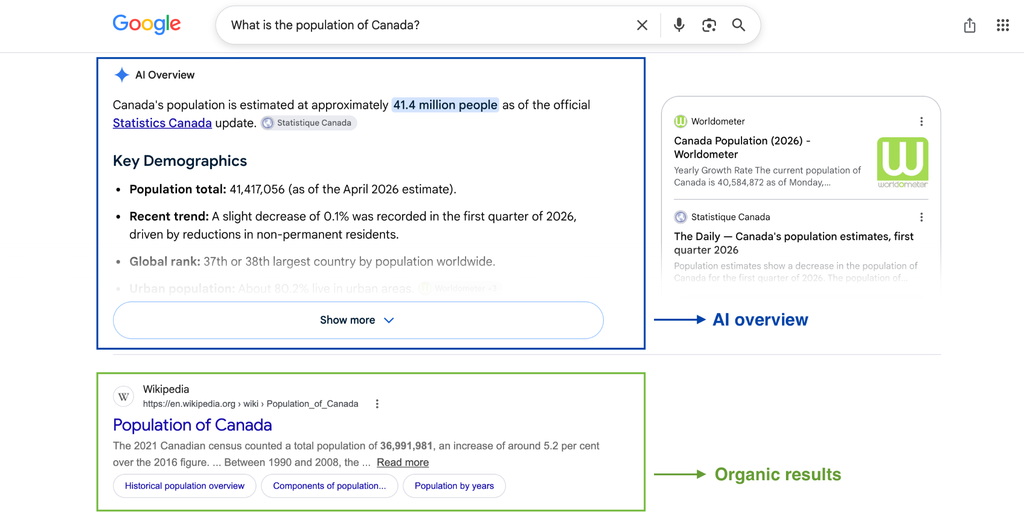
This new structure means that users interact with the overviews first, then proceed to the search results below if the overviews don’t provide all the information. It demonstrates why getting cited in AI overviews is now as important as getting cited in organic search results.
New UI patterns: Follow-up questions, source cards, and citations
AI overviews don’t just output summaries. They also include citations from which the overviews were obtained, source cards, and suggested follow-up questions.
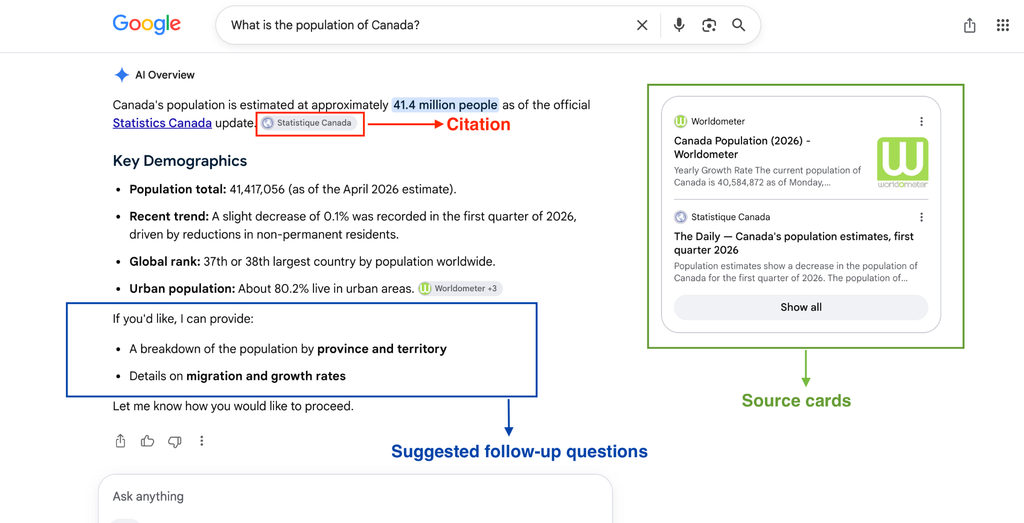
In the above screenshot, you can see how a citation, source card, and suggested follow-up questions are clearly included in an AI-generated overview.
Who feels the impact first: Segments most at risk
AI overviews moving to the top of search results pages means less attention paid to links below. Note that AI overviews don’t appear for all search queries, but are estimated to appear on 48% of all queries, reducing clicks by up to 58%. They’re shown when algorithms determine that an overview adds value to a complex search query.
Reduced Google clicks have affected some website niches more than others. For example, informational publishers that produce guides to straightforward questions like “What is the population of Canada?” and “How does blockchain work?” have seen noticeably reduced clicks. Ad-dependent news publications have also been affected, and so have some niche sites on personal finance, technology, healthcare, and other topics.
On the other hand, Google intentionally restricts overviews for some topics like mental and physical health, fast-breaking news, and some political content (e.g., live voting information and election procedures), so these niches have seen less impact.
To mitigate the damage, affected sites have focused on optimising for Google SGE snippets and overviews as much as they do on links.
Measuring the real damage: Metrics beyond rankings
To know if your website is affected, you need to look at the complete picture of impressions, clicks, click-through rates, and conversions. Examining these stats in aggregate lets you know if your website’s traffic has been dented by Google’s SGE update.
Impressions without clicks: The zero-click acceleration
You may be getting a lot of impressions but notice that the percentage of people clicking on your links has dropped. A lower click-through rate (CTR) could be from AI overviews giving users summarised answers, reducing their need to click through to your website, even when the answer was sourced from your site.
As users can now find answers to their queries from overviews, there has been a general trend of reduced clicks, so you’re not alone if you notice it.
CTR decay by position and query type
Click-through rates often drop for straightforward queries, the type where an AI overview is most likely to show up. For example, if someone searches for “What’s the largest country by population,” an AI overview will easily answer their question. If you’ve written an article about “The world’s largest countries by population,” you’ll likely notice a CTR drop because of Google’s SGE answers.
AI overviews are less likely to appear for local searches, shopping queries, and recent breaking news. For example, someone searching for “Buy corporate shoes size 11” won’t always see overviews. If you create localised content or e-commerce product pages, you’re less likely to observe CTR drops.
How to stay visible: A practical playbook
You’ve learned how the search generative experience has affected website traffic and increased the need to optimise for AI citations. What’s the practical way to respond to these Google SGE effects and avoid traffic loss? Here’s a playbook to follow.
Need a partner to create and implement the right AI optimisation playbook for your website? Why SEO Serious is around the corner with our expertise in elevating AI rankings.
Action plan: Preparing your team and stack
Inform your content team about the paradigm shift and why your strategy must move beyond chasing keyword rankings to also optimising for AI-generated answers. The team needs to put in considerable effort to get your website recognised as a trusted, citable source, so give them the required resources and leeway to implement new strategies.
Auditing your current visibility exposure
Evaluate your website’s current exposure to the effects of the SGE search rollout. Have you lost significant traffic lately? Have impressions stayed steady while conversions dropped? Has your CTR steadied or reduced over time? Google Search Console helps you easily measure these search performance metrics. Google’s free Analytics tool also helps.
Prioritising content and technical fixes
Based on your visibility exposure, prioritise immediate content and technical fixes to avoid losing traffic. Structure content like “answer assets,” with data-backed straightforward answers placed at the top, then deeper explanations below. Use headings, bullet points, and tables to highlight data that AI crawlers can easily extract. Write in a conversational, explanatory style.
- Picture an article discussing “The Population of Canada,” and it just had bland text stating Canada’s current population. It may not be cited in AI overviews. However, if we add key facts to the article, including population growth over the past decade and the number of new additions in each year, citing government data, there’s now a lot to pick from the article, and it’ll likely get cited in an overview.
- How about another article discussing “The Fastest-growing Economies” with just a bland list of the top ten fastest growing economies as highlighted in the World Bank’s annual report. Then, we update this article to state the exact growth rate of each country, their GDP, GDP per capita, and gross national income per capita between the current and previous year, the article becomes rich with details. There’s now a lot for AI algorithms to parse and cite in an overview.
Ensure your site has the right schema markup to highlight data like FAQs, events, blog posts, operating hours, dates, and more. Your robots.txt file should allow for proper indexing of all relevant pages (this file instructs crawlers on which content to crawl and which to avoid).
Building an AI-readiness roadmap
The initial efforts are just the beginning. You need to create a roadmap to ensure your website’s AI readiness in the long term. The roadmap can follow this format:
Foundational audit
- Content audit. Evaluate your current citations and brand mentions in AI overviews.
- Technical audit. Evaluate your website’s schema markup structure and robots.txt file to ensure proper indexing.

Optimisation
- Content strategy. Restructure existing and new content to use a conversational tone, with data-backed answers that AI crawlers can easily cite.
- Technical optimisation. Implement the right schema markup, adjust your robots.txt file if needed, and optimise for fast loading speeds and mobile-friendliness.
Evaluation
- Traffic monitoring. Monitor for improved traffic from AI citations over time. Compare week-to-week, month-to-month, and quarter-to-quarter for improvements. If you don’t get the desired results, you can optimise the site further.
Tracking, testing, and iterating
As we hinted at above, the last part of the playbook is tracking your website’s metrics for improved metrics. If you don’t get the ideal results, test other strategies and feel free to iterate to get better results.
There’s really no guaranteed method of getting cited in SGE snippets. Rather, there are general strategies that boost your chances of doing so, but it can differ based on your website’s niche, audience, and content. What matters is constantly monitoring the results and being able to iterate to boost SGE rankings.

How to measure success in AI Overviews
How do you measure your website’s SGE ranking? Pay attention to these metrics:
- Citation frequency. How often is your website cited or linked inside Google AI Overviews? The larger the number, the better.
- Brand share. How often is your brand name mentioned in overviews compared to competitors? Your aim should always be to outrank the competition.
- Sentiment. When your brand is mentioned, what tone is it mentioned in? It can be positive, neutral, or negative, and you need more positive sentiment than negative or neutral.
Typical analytics tools, such as Google Analytics, don’t track the above metrics, but a new crop of AI visibility tools have emerged to fill in the gap. Profound, OtterlyAI, and Peec AI are examples of such visibility tools.
Conclusion
Google’s Search Generative Experience (SGE) is here to stay, so website owners have to adapt. We’ve discussed the effects of this paradigm shift and how to stay visible amid the rapid changes.
Do you need help in adjusting to the SGE era? Look no further than Why SEO Serious to restructure your content for AI citations and improved traffic.
Contact us today to see how we can elevate your AI rankings.
Frequently asked questions
What is Google SGE?
It’s the Search Generative Experience, a revamped experience where users now see AI overviews at the top of search results and links below. The AI overview is the first highlight for many queries, so users pay more attention to it on a Google page.
What are AI overviews?
An AI overview is an AI-generated summary of an answer sought by the user. The answer is sourced from multiple web pages and displayed at the very top of a search results page.
Why are search engine rankings no longer the main indicator of SEO effectiveness?
AI overviews have moved to the top of search results pages, making users pay more attention to them than the links below. This means that SEO is no longer just about links being ranked high, but also about getting cited in overviews at the very top of a page.
How can a website stay visible in the era of AI search?
Your website can stay visible by revamping its content strategy to use a conversational tone, provide straightforward, data-backed answers in the first sections of articles, and use headings, bullet points, and tables to highlight data for AI crawlers. Also, implement schema markup to highlight key data and optimise your website’s speed, mobile-friendliness, and robots.txt file.